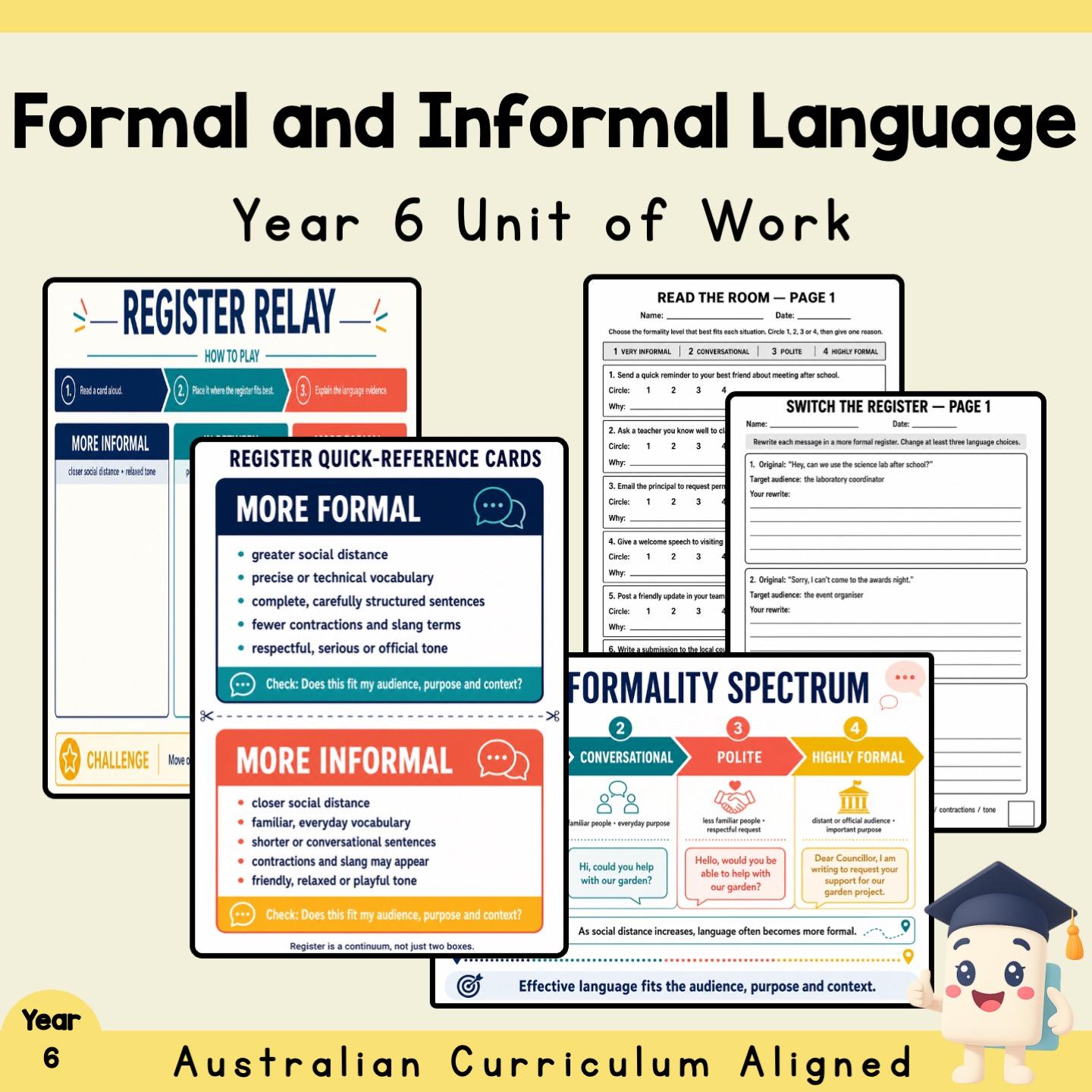
Formal and Informal Language — Year 6
Click here to preview this resource
About this unit
Formal and Informal Language — Year 6 is a complete teaching sequence that helps students move beyond a simple formal-or-informal label. Students learn how register operates on a continuum and how vocabulary, sentence structure, contractions, tone, greetings and sign-offs respond to relationships, authority, purpose and setting.
The unit begins with an editable 20-slide lesson and practical colour references. Register Relay and Audience & Purpose Challenge provide collaborative sorting and decision-making practice. Five worksheet sets then develop evidence finding, analysis, message transformation, ranking and planning. Students finish with a mixed-format editable quiz and the two-part Community Voices Assessment, supported by matching answer pages and a five-level marking rubric.
The teaching materials use Australian English and age-appropriate school and community contexts. Formal language is presented as a purposeful choice, not as automatically better, while cultural and relationship factors are treated respectfully.
What's included
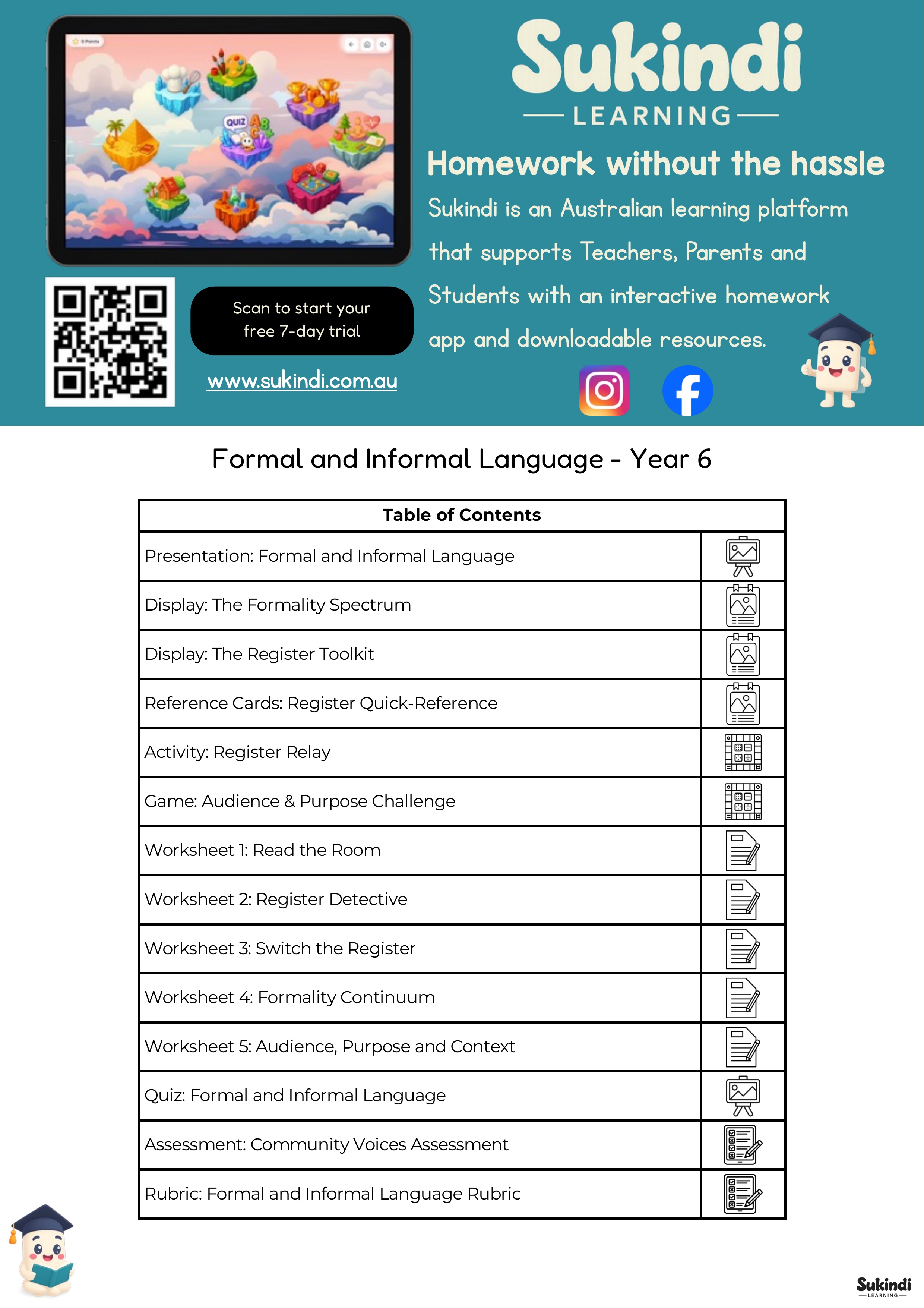
Editable 20-slide PowerPoint presentation: Formal and Informal Language
Editable 22-slide PowerPoint quiz: 10 mixed questions with answer/explanation pairs
32-page A4 unit plan PDF
Colour displays: The Formality Spectrum; The Register Toolkit
Colour reference sheet: Register Quick-Reference Cards
Colour Register Relay activity: Cards A, Cards B and Sorting Mat
Colour Audience & Purpose Challenge game: Scenario Cards and Decision Board
Read the Room: two student pages and two matching answer pages
Register Detective: two student pages and two matching answer pages
Switch the Register: two student pages and two matching answer pages
Formality Continuum: one student page and one matching answer page
Audience, Purpose and Context: two student pages and two matching answer pages
Community Voices Assessment: two student pages and two suggested-answer pages
Formal and Informal Language Rubric: five levels, A4 landscape
11 answer/suggested-answer pages in total
Learning focus
Recognise register as a set of language choices shaped by the communication situation.
Identify evidence of formality in vocabulary, grammar, sentence structure and tone.
Explain the influence of social distance, familiarity and authority.
Select a suitable register for audience, purpose and context.
Adapt the same core message for audiences with different relationships.
Justify language choices using precise evidence.
Classroom use
Use the presentation for explicit teaching, the displays and reference cards for ongoing support, Register Relay for collaborative classification, Audience & Purpose Challenge for oral reasoning, and the five worksheet sets for guided-to-independent practice. The Community Voices task and rubric provide an end-of-unit assessment. The full sequence suits approximately five lessons plus assessment, while individual components can also be used separately for revision or small-group support.
Year, subject and topic
Year level: Year 6
Subject: English
Topic: Formal and informal language, register, audience, purpose, context and social distance
Curriculum alignment
Australian Curriculum v9
AC9E6LA01 — understand that language varies as levels of formality and social distance increase.
Australian Curriculum v8.4
ACELA1516
Victoria Curriculum 2.0
VC2E6LA01
New South Wales
EN3-OLC-01
Western Australia
WA6ELAI1
Common Core State Standards
CCSS.ELA-LITERACY.L.6.1.e; CCSS.ELA-LITERACY.SL.6.1.b; CCSS.ELA-LITERACY.W.6.2.e
England Key Stage 3
UK-KS3-ENG-SPK; UK-KS3-ENG-G
New Zealand Curriculum
NZ-Y6-ENG-OL-IC-CVTVP-1
Texas Essential Knowledge and Skills
TEKS-ELAR-G6-6H; TEKS-ELAR-G6-9F; TEKS-ELAR-G6-1; TEKS-ELAR-G6-1A; TEKS-ELAR-G6-1B; TEKS-ELAR-G6-1C; TEKS-ELAR-G6-2; TEKS-ELAR-G6-11D; TEKS-ELAR-G6-12A
Ontario Language Curriculum
CAN-G6-LANG-B1.3; CAN-G6-LANG-B1.4; CAN-G6-LANG-B1.5
Formats, page counts and answers
Customer formats: PDF and editable PowerPoint PPTX
Unit plan: 32 A4 pages
Presentation: 20 editable slides
Quiz: 22 editable slides
Answer-key status: Included — nine worksheet answer pages and two assessment suggested-answer pages
Print treatment: Colour displays and activities; black-and-white worksheets, assessment and rubric; red answers on matching answer pages
Teacher benefits
Provides a sequenced week from explicit teaching through practice and assessment.
Includes ready-to-use examples across school, peer and community audiences.
Offers collaborative, written and assessment formats in one aligned unit.
Supplies matching answers and a five-level rubric for efficient feedback.
Keeps lesson and quiz text editable in PowerPoint.
Digital product and licence
This is a digital product; no physical item is supplied. Purchase grants a single-classroom licence to the original purchaser. Files may be used with the purchaser's own students but may not be shared, resold, redistributed, posted publicly or uploaded to a shared drive accessible outside that classroom licence.