Letter Recognition Foundation Unit
Click here to preview this resource
About this unit
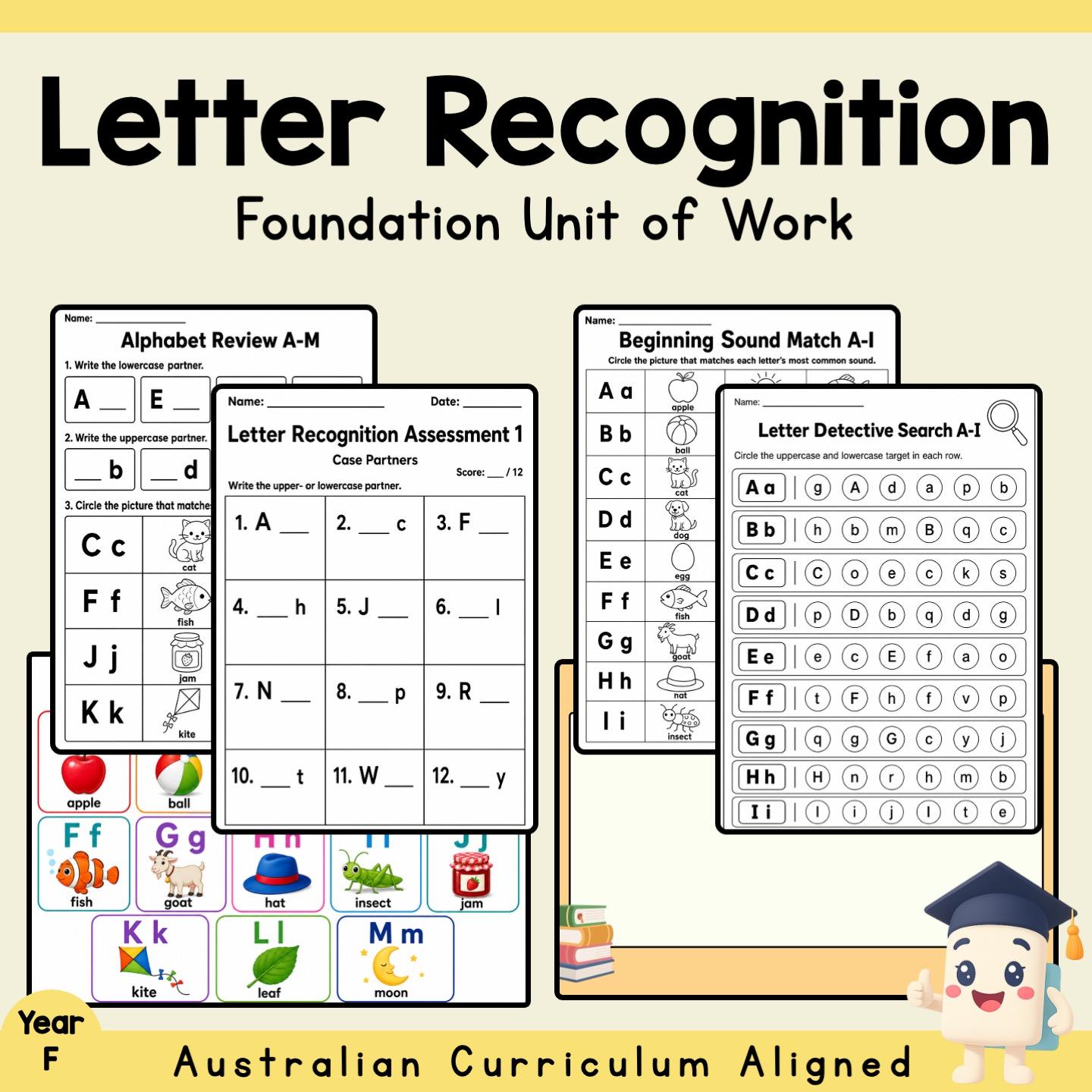
Teach uppercase and lowercase letter recognition through a clear sequence of explicit instruction, active practice and independent assessment. This Foundation unit helps children name letters, match case partners, distinguish easily confused forms and connect letters with their most common sounds.
The editable presentation introduces all 26 letters in manageable groups and models visual cues for b/d, p/q, m/n and u/v. Colour displays, memory cards, mixed-case bingo and a movement relay give children repeated hands-on practice. Five differentiated worksheet sets progress from writing partners and following alphabet paths to visual searches, sound-picture matching and mixed review. A personal name activity adds meaningful application, while two assessment pages and a five-level rubric support teacher judgement.
Fixed-response practice and assessment pages include matching red-answer versions placed immediately after the student page.
What's included
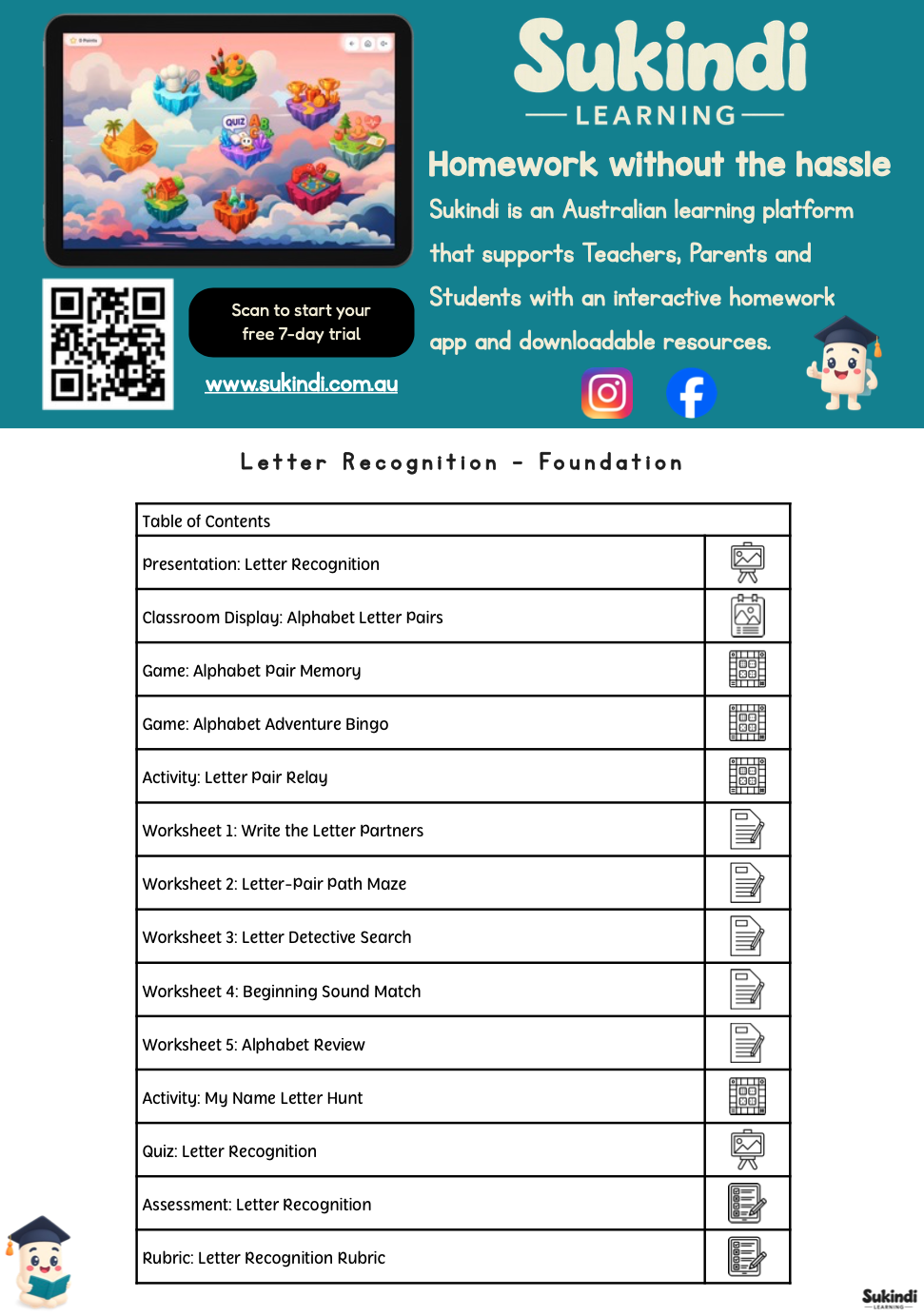
44-page unit plan PDF
Editable 19-slide Letter Recognition PowerPoint presentation
Editable 22-slide Letter Recognition PowerPoint quiz with 10 question-and-answer pairs
Alphabet Letter-Pairs Displays A-M and N-Z
Alphabet Pair Memory Cards A-G, H-M, N-T and U-Z
Alphabet Adventure Bingo instructions and four mixed-case boards
Letter Pair Relay instructions and team mat
Write the Letter Partners A-M and N-Z
Letter-Pair Path Maze A-M and N-Z
Letter Detective Search A-I, J-R and S-Z
Beginning Sound Match A-I, J-R and S-Z
Alphabet Review A-M and N-Z
My Name Letter Hunt
Letter Recognition Assessment 1: Case Partners
Letter Recognition Assessment 2: Letter Sounds
14 red-answer pages
Letter Recognition Rubric with five performance levels
Learning focus
Name uppercase and lowercase letters
Match uppercase and lowercase partners
Notice and distinguish similar letterforms
Recall common sounds represented by letters
Apply alphabet knowledge during games, name work and assessment
Classroom use
Use the presentation for whole-class teaching, the display pages as a visual reference, the card and board games in literacy centres, and the worksheets for guided, independent or home practice. The two assessments can be used separately or together at the end of the sequence. Suggested duration is one school week, with reusable game materials for ongoing revision.
Year, subject and topic
Year level: Foundation / Kindergarten
Subject: English
Topic: Letter recognition, uppercase and lowercase letters, alphabet knowledge and common letter sounds
Curriculum alignment
Australian Curriculum v9.0
AC9EFLY11
Australian Curriculum v8.4
ACELA1440
Victorian Curriculum 2.0
VC2EFLY06
NSW Curriculum
ENE-PHOKW-01
Western Australian Curriculum
WAPELAP3
Common Core State Standards
RF.K.1.d; RF.K.3.a; RF.K.3.b; RF.K.3.d
Texas Essential Knowledge and Skills
GK-2; GK-2B; GK-2C; GK-2D
Ontario Language Curriculum
CAN-G1-LANG-B2.2; CAN-G1-LANG-B2.3
England National Curriculum
UK-KS1-Y1-ENG-R-WR
New Zealand Curriculum
NZ-Y0/Y1-ENG-R-WR-PPK-3
Formats, page counts and answers
Unit plan: 44 pages
Presentation: 19 slides
Quiz: 22 slides
Answer key: Included; 14 red-answer pages
Teacher benefits
A complete teaching, practice and assessment sequence in one coordinated unit
Editable native PowerPoint lesson and quiz text
Print-friendly black-and-white student pages
Reusable colour game and display materials
Immediate red-answer references for efficient checking
Differentiated whole-alphabet practice across manageable letter groups
Digital product and licence
This is a digital product; no physical item is shipped. Purchase permits use by the purchasing teacher/classroom under Sukindi's licence terms. Files may not be resold, shared publicly, redistributed or uploaded to an unrestricted shared drive.