Repeated Chance Experiments — Year 4
Click here to preview this resource
About this unit
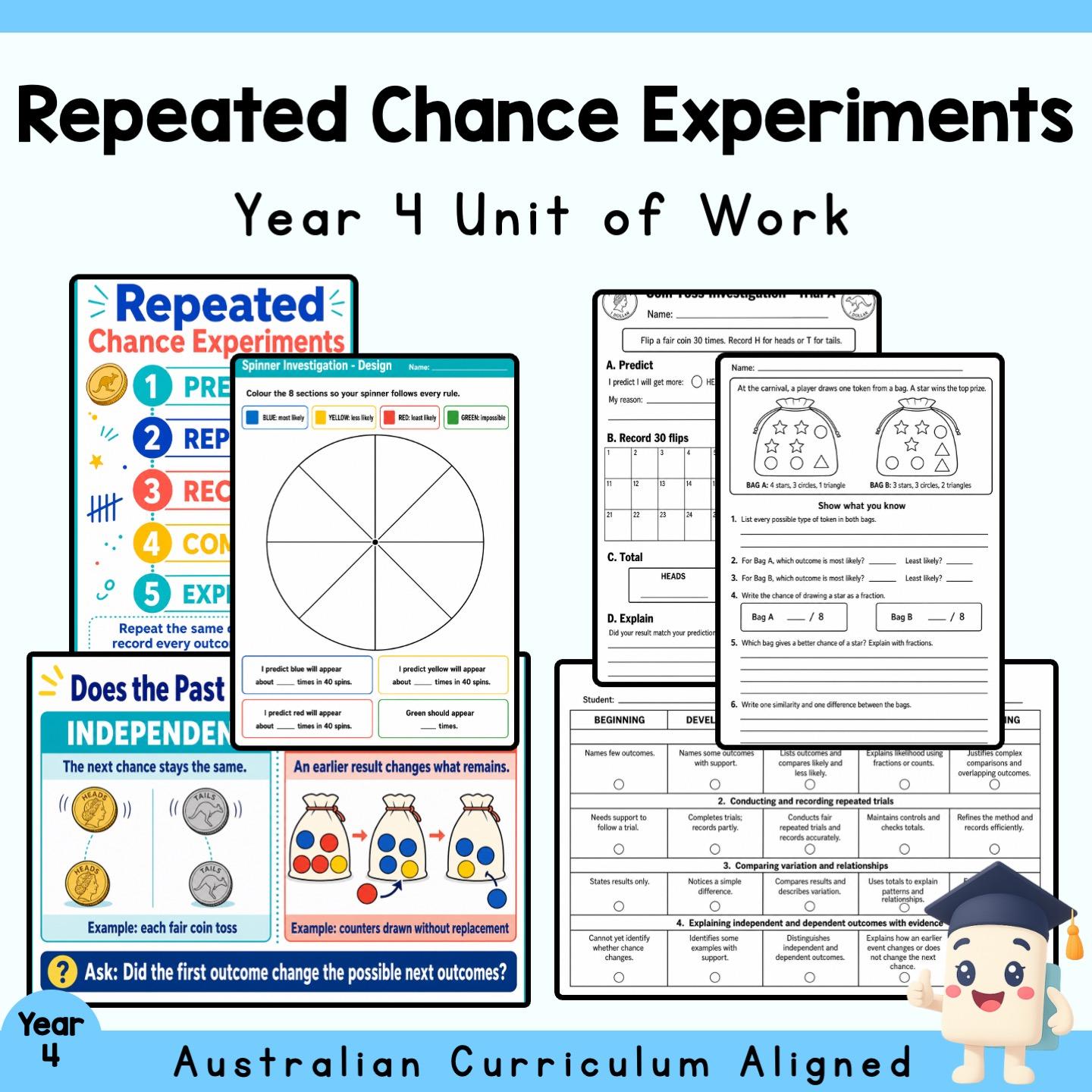
Repeated Chance Experiments gives Year 4 students a practical way to investigate chance with evidence. Across the unit, students list possible outcomes, use likelihood language, conduct repeated trials, compare separate result sets and explain natural variation. They also distinguish independent outcomes, such as successive fair coin tosses, from dependent outcomes in which an earlier event changes what remains.
The teaching sequence follows five memorable steps: predict, repeat, record, compare and explain. Students design and test an unequal spinner, investigate whether the first move relates to game results, collect and compare coin-toss data, analyse given experimental results and plan a fair repeated chance experiment.
The 30-page unit plan provides a full week of classroom materials. Colour displays and activity/game pages support modelling and collaborative learning. Black-and-white worksheets and assessment pages are economical to print. Eight matching answer pages place fixed answers in red on the student layout, and a five-level rubric supports consistent marking. The included editable PowerPoint presentation contains 13 slides, while the editable 22-slide quiz provides 10 question-and-answer pairs for review.
What's included
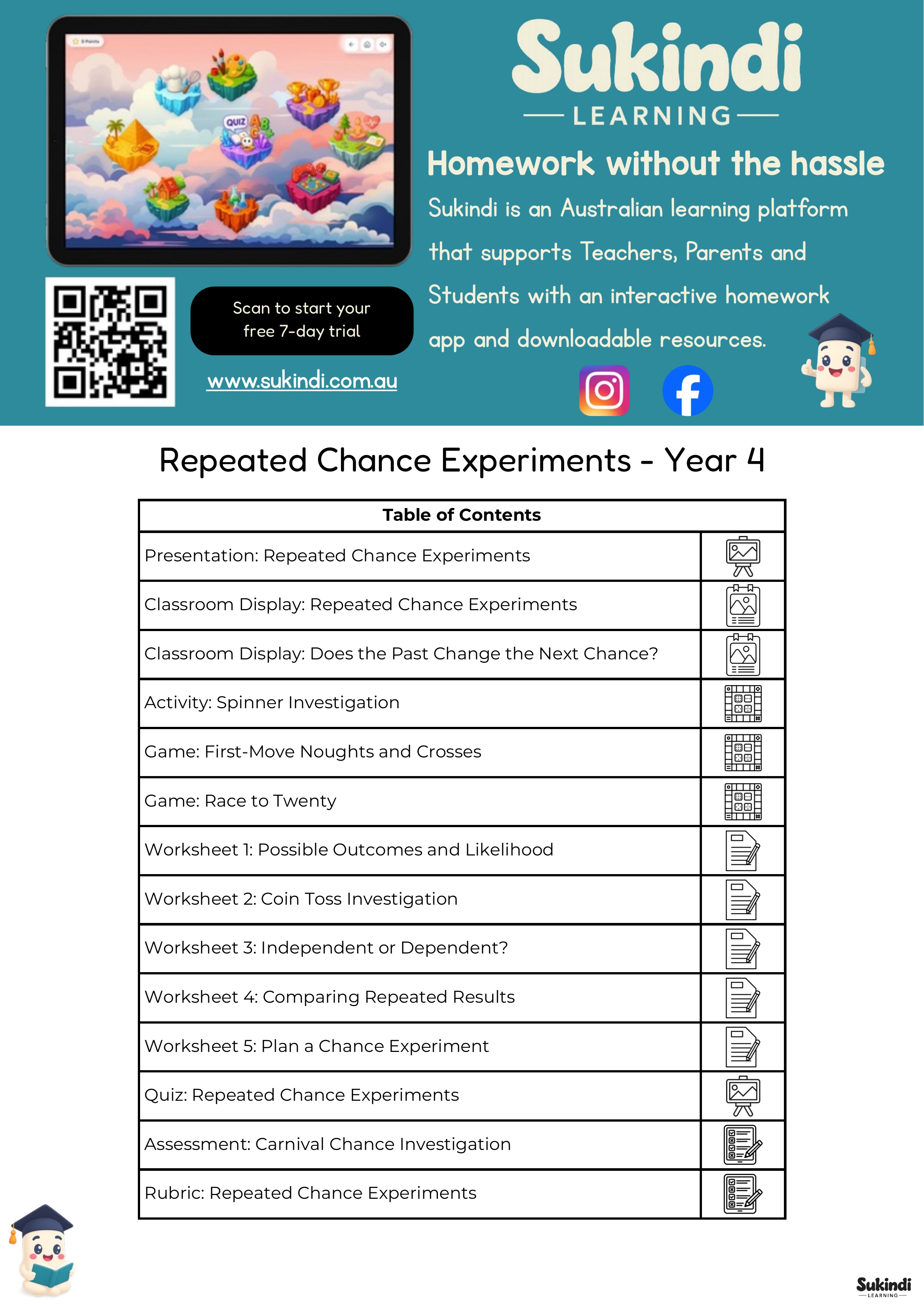
Repeated Chance Experiments Presentation.pptx — 13 editable slides
Repeated Chance Experiments Quiz.pptx — 22 editable slides with 10 question-and-answer pairs
Repeated Chance Experiments - Unit Plan.pdf — 30 pages
Classroom Display: Repeated Chance Experiments
Classroom Display: Does the Past Change the Next Chance?
Activity: Spinner Investigation — 2 pages
Game: First-Move Noughts and Crosses — 2 pages
Game: Race to Twenty — 2 pages
Worksheet 1: Possible Outcomes and Likelihood — 2 student pages and 2 answer pages
Worksheet 2: Coin Toss Investigation — 2 student-generated-data pages
Worksheet 3: Independent or Dependent? — 2 student pages and 2 answer pages
Worksheet 4: Comparing Repeated Results — 2 student pages and 2 answer pages
Worksheet 5: Plan a Chance Experiment — 2 student planning pages
Assessment: Carnival Chance Investigation — 2 student pages and 2 answer pages
Rubric: Repeated Chance Experiments — 5 performance levels
Learning focus
Identify and compare possible outcomes.
Describe likelihood without confusing probability with certainty.
Conduct repeated experiments fairly and record every result.
Compare data from two repeated trials and explain variation.
Recognise when outcomes are independent or dependent.
Investigate relationships between first moves, strategies and game results.
Plan a testable chance question and support a conclusion with data.
Classroom use
Use the editable presentation to introduce one concept per lesson, then select the paired display, activity, game or worksheet for guided and independent practice. The quiz can be used interactively for review or as a whole-class check for understanding. Finish with the two-page Carnival Chance Investigation and rubric, or use the planning worksheet as an extension investigation.
YEAR, SUBJECT AND TOPIC
Year level: Year 4 / Grade 4
Subject: Mathematics
Strand/topic: Probability — repeated chance experiments and relationships between outcomes
Curriculum alignment
Australian Curriculum v9.0: AC9M4P02
Australian Curriculum v8.4: ACMSP145
Victorian Curriculum 2.0: VC2M4P02
NSW Curriculum: MA2-CHAN-01
Western Australian Curriculum: ACMSP145
United States Common Core: CCSS.MATH.CONTENT.4.MD.B.4; CCSS.MATH.CONTENT.4.OA.A.3
United Kingdom: UK-UKS2-Y5-MATH-S; UK-LKS2-Y4-MATH-N-M
New Zealand: NZ-Y4-MATH-PROB-PI-1; NZ-Y5-MATH-PROB-PI-1
Texas Essential Knowledge and Skills: TEKS-MATH-G4-1A; TEKS-MATH-G4-1B; TEKS-MATH-G4-1F; TEKS-MATH-G4-9A; TEKS-MATH-G4-9B
Ontario Curriculum: CAN-G4-MATH-D2.1; CAN-G4-MATH-D2.2
Formats, page counts and answers
Printable unit-plan length: 30 pages
Presentation length: 13 slides
Quiz length: 22 slides
Answer support: 8 matching red-answer pages plus 10 quiz answer slides
Suggested duration: Approximately one teaching week, with optional extension, review and assessment sessions
Teacher benefits
A sequenced path from possible outcomes to evidence-based investigation.
Practical activities that make repeated trials visible and discussable.
Multi-page worksheets with sufficient recording and explanation space.
Consistent black-and-white print pages and colour reusable materials.
Matching answer layouts that reduce checking time.
Editable presentation and quiz text for classroom adaptation.
An assessment and five-level rubric aligned to the unit focus.
Digital product and licence
This is a digital product; no physical item is shipped. Purchase permits use by one teacher with their own classes. Do not publicly share, redistribute, resell or upload the files to an unrestricted website or shared drive.