Responding to Literature Year 3
Click here to preview this resource
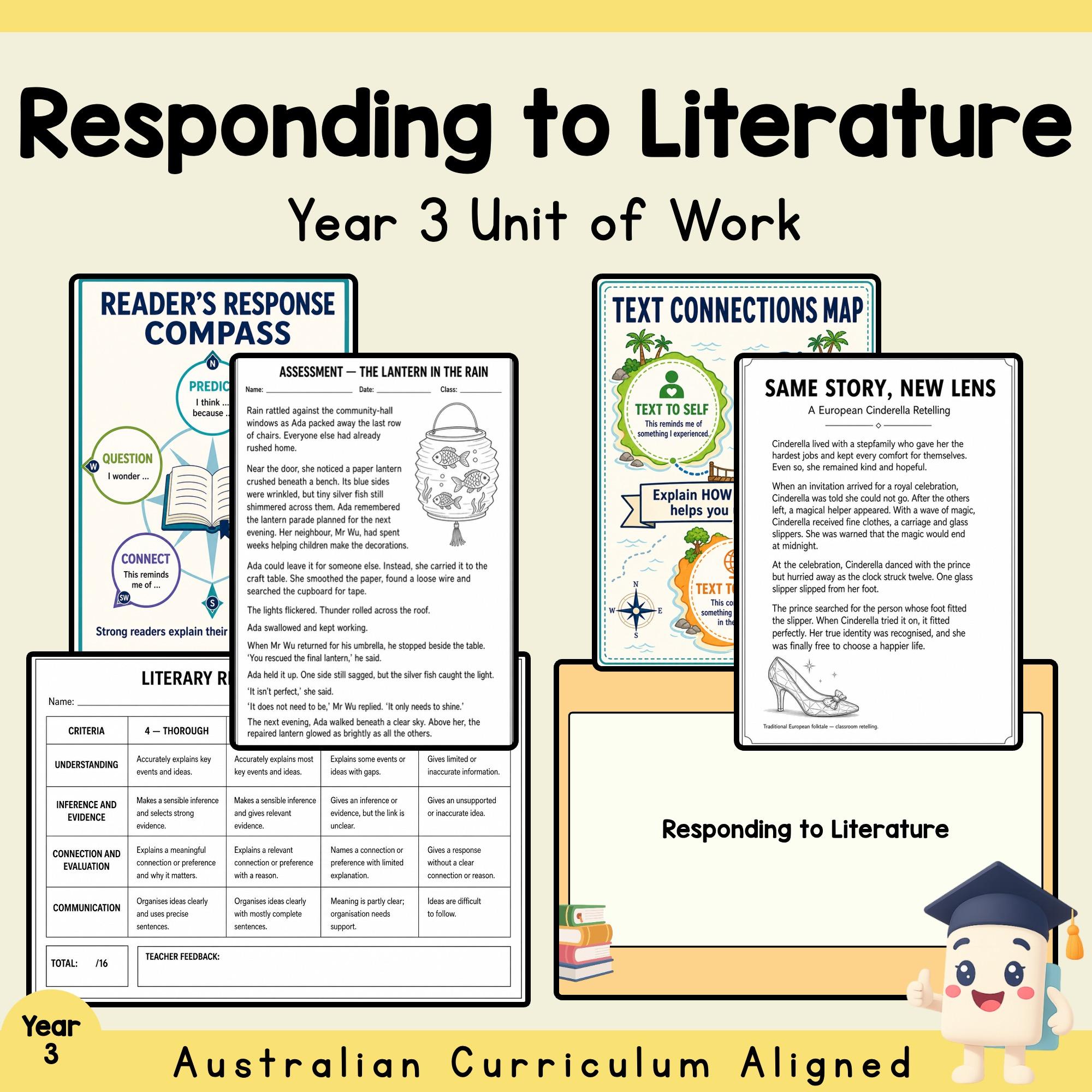
Responding to Literature helps Year 3 students explain their thinking about stories with clarity and evidence. Across explicit teaching, partner discussion, hands-on activities, differentiated written practice and assessment, students learn to retrieve literal information, infer meaning, connect character experiences with their own lives and evaluate literary texts.
The editable 20-slide presentation introduces a practical response compass: predict, question, clarify, connect and share an opinion. It models how to infer from actions, dialogue, thoughts and reactions; how setting and word choice create mood; how context changes story details; and how to support a preference with a reason and relevant evidence.
The 36-page unit plan PDF combines polished colour displays and activity materials with low-ink worksheets. Students compare fresh classroom retellings, investigate character evidence, practise mood-changing word choices, build meaningful connections, plan a story remix and complete an independent literature response. The sequence culminates in the original three-page assessment, The Lantern in the Rain, with matching answer pages and a four-level rubric.
The editable 22-slide quiz provides 10 question-and-answer pairs using true-or-false, multiple-choice and short-answer formats. It offers a quick, engaging check of the unit's key concepts.
What's Included
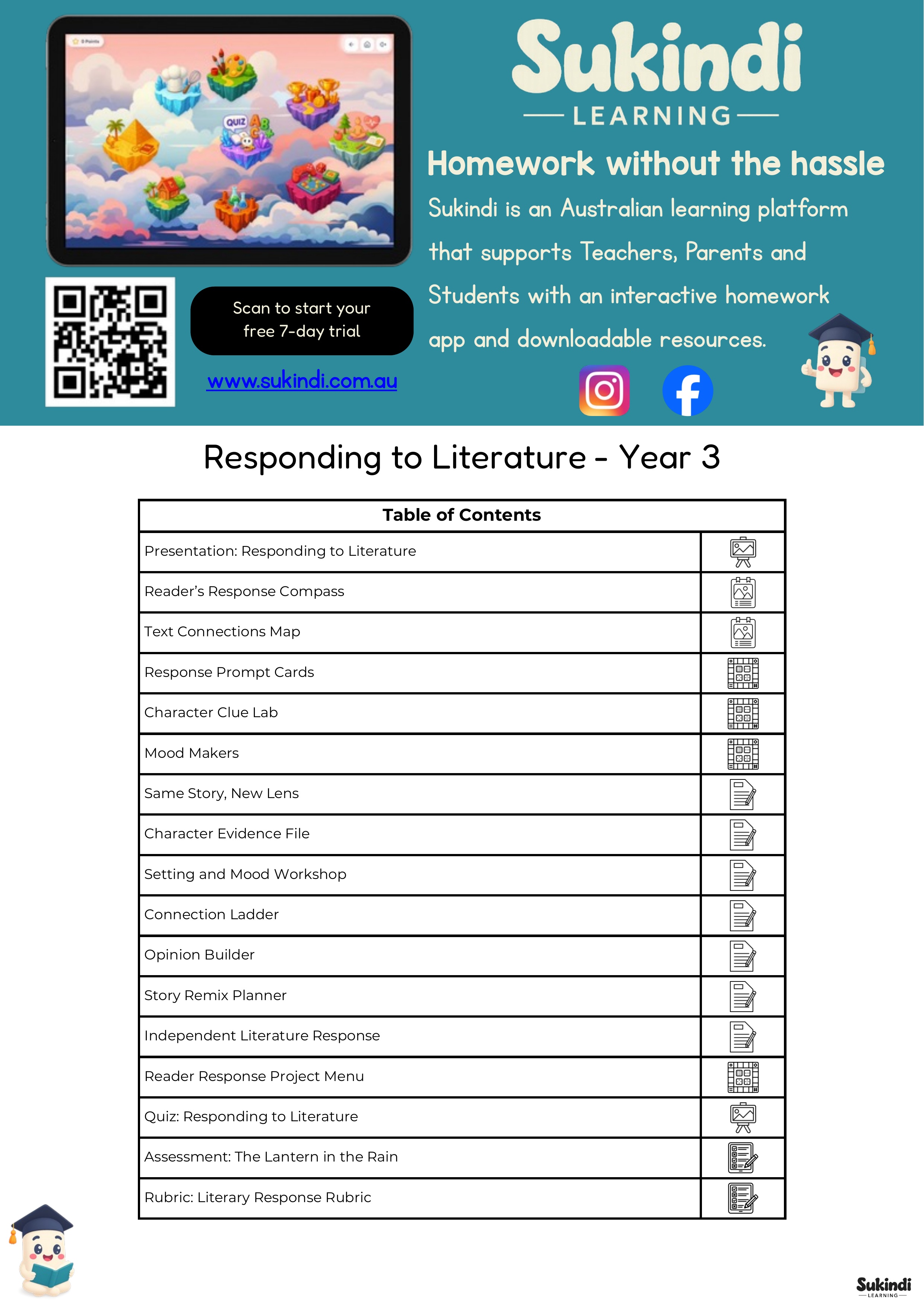
Editable presentation — 20 slides
Editable quiz — 22 slides, including 10 question-and-answer pairs
Unit plan PDF — 36 pages
Reader's Response Compass — 1 colour display page
Text Connections Map — 1 colour display page
Response Prompt Cards — 2 colour cut-apart card pages
Character Clue Lab — 2 colour game/activity pages
Mood Makers — 2 colour game/activity pages
Same Story, New Lens — 3 student pages and 1 answer page
Character Evidence File — 2 student pages and 1 answer page
Setting and Mood Workshop — 2 student pages and 2 answer pages
Connection Ladder — 2 differentiated student pages
Opinion Builder — 2 student pages and 1 model-answer page
Story Remix Planner — 2 student pages
Independent Literature Response — 2 reusable student pages
Reader Response Project Menu — 1 colour choice page
Assessment: The Lantern in the Rain — 3 student pages and 2 answer pages
Literary Response Rubric — 1 page
Seven answer or model-answer pages in total
Learning Focus
Students learn to:
discuss connections between their experiences and character experiences
explain how a connection supports understanding
retrieve literal information and infer unstated meaning
infer character traits, feelings and motives from textual evidence
explain how setting details and language choices create mood
compare two tellings and consider the influence of context
summarise the most important narrative events
state and justify a personal literary preference
use comprehension strategies before, during and after reading
Classroom Use
Use the presentation for whole-class modelling, the colour displays as ongoing classroom references and the prompt cards or game mats for partner talk, literacy groups or rotations. The worksheets support guided, core and independent practice. Finish with the assessment, rubric and editable quiz, or select individual activities to support an existing literature study.
Product Details
Year level: Year 3
Subject: English
Topic: Responding to literature, reading comprehension, literary response, character experiences, inference, text connections, setting, mood and supported preferences
Suggested duration: Approximately 5–8 lessons; flexible for one focused week or up to two weeks
Curriculum Alignment
Australian Curriculum Version 9.0
AC9E3LE02 — discuss connections between personal experiences and character experiences in literary texts and share personal preferences.
AC9E3LY05 — use comprehension strategies when listening and viewing to build literal and inferred meaning, and begin to evaluate texts using knowledge of context, text structures and language features.
Australian Curriculum Version 8.4
ACELT1596
ACELT1598
ACELY1680
Victorian Curriculum 2.0
VC2E3LE02
VC2E3LY10
NSW English
EN2-OLC-01
EN2-RECOM-01
EN2-UARL-01
EN2-VOCAB-01
Western Australian Curriculum
WA3ELIEN1
WA3ELYA3
Common Core State Standards — English Language Arts
CCSS.ELA-LITERACY.RI.3.1
CCSS.ELA-LITERACY.RI.3.2
CCSS.ELA-LITERACY.RI.3.3
CCSS.ELA-LITERACY.RI.3.4
CCSS.ELA-LITERACY.RI.3.9
CCSS.ELA-LITERACY.RI.3.10
CCSS.ELA-LITERACY.RL.3.1
CCSS.ELA-LITERACY.RL.3.3
CCSS.ELA-LITERACY.RL.3.9
CCSS.ELA-LITERACY.RL.3.10
CCSS.ELA-LITERACY.RF.3.4.a
CCSS.ELA-LITERACY.RF.3.4.b
CCSS.ELA-LITERACY.L.3.3
CCSS.ELA-LITERACY.L.3.4
CCSS.ELA-LITERACY.L.3.4.d
CCSS.ELA-LITERACY.SL.3.1.d
CCSS.ELA-LITERACY.W.3.2.b
CCSS.ELA-LITERACY.W.3.7
CCSS.ELA-LITERACY.W.3.8
CCSS.ELA-LITERACY.W.3.10
England — Lower Key Stage 2 English
UK-LKS2-ENG-R-C
UK-LKS2-ENG-W-C
UK-LKS2-Y4-ENG-SPK
New Zealand English
NZ-Y3-ENG-R-CA-CR-1
NZ-Y3-ENG-R-CA-IP-1
NZ-Y3-ENG-R-C-CM-1
NZ-Y3-ENG-R-C-V-1
Texas Essential Knowledge and Skills — English Language Arts
TEKS-ELAR-G3-6
TEKS-ELAR-G3-6B
TEKS-ELAR-G3-6C
TEKS-ELAR-G3-6D
TEKS-ELAR-G3-6E
TEKS-ELAR-G3-6F
TEKS-ELAR-G3-6G
TEKS-ELAR-G3-6H
TEKS-ELAR-G3-6I
TEKS-ELAR-G3-7
TEKS-ELAR-G3-7A
TEKS-ELAR-G3-7C
TEKS-ELAR-G3-7D
TEKS-ELAR-G3-7E
TEKS-ELAR-G3-7F
TEKS-ELAR-G3-7G
Ontario Language
CAN-G3-LANG-C2.1
CAN-G3-LANG-C2.3
CAN-G3-LANG-C2.4
CAN-G3-LANG-C2.5
CAN-G3-LANG-C2.7
CAN-G3-LANG-C3.2
CAN-G3-LANG-C3.3
CAN-G3-LANG-C3.5
CAN-G3-LANG-C3.6
CAN-G3-LANG-C3.7
CAN-G3-LANG-C3.8
Formats, Page Counts and Answers
File formats: PDF and editable Microsoft PowerPoint
Page and slide count: 78 total — 36-page unit plan, 20-slide presentation and 22-slide quiz
Answer key included: Yes — 7 answer or model-answer pages and 10 quiz answer slides
Digital product: Yes
Teacher Benefits
A sequenced pathway from oral rehearsal and modelling to independent written response
Reusable tools that work with many literary texts
Differentiated prompts and generous response space for Year 3 learners
Objective and model answers placed directly after the related student pages
An editable presentation and quiz for flexible classroom delivery
Assessment and rubric evidence aligned with the stated learning focus
Digital Product and Licence
This is a digital product; no physical item will be shipped. Purchase permits use by the individual purchaser in their own classroom or teaching setting. Please do not share, resell, redistribute, upload publicly or claim the files as your own. Additional educators require additional licences.