Symbol Exploration Foundation Unit
Click here to preview this resource
About this unit
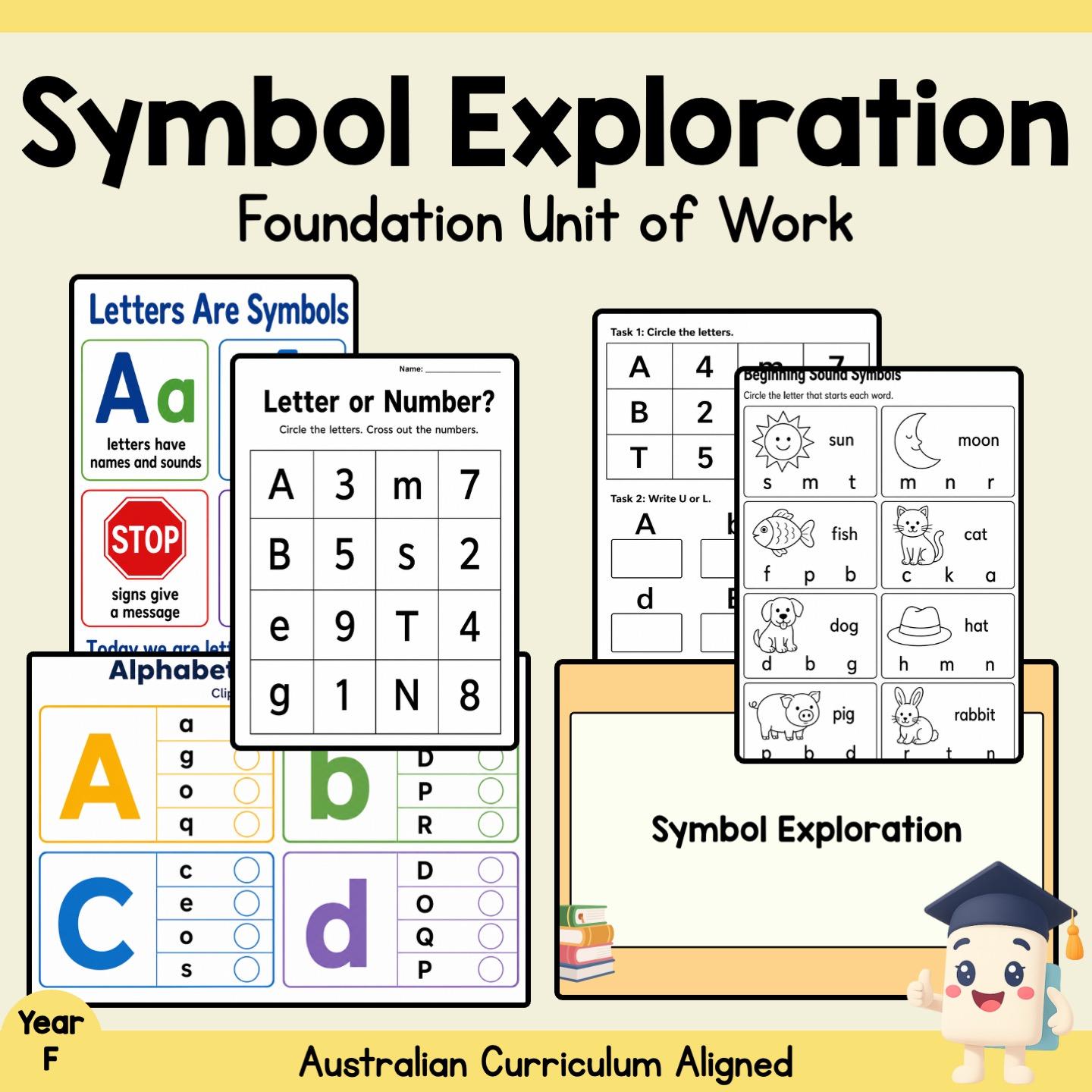
Symbol Exploration gives Foundation and Kindergarten teachers a structured week of early literacy teaching focused on letters as meaningful symbols. Children learn to distinguish letters from numbers and signs, name and match uppercase and lowercase forms, notice straight and curved letter features, and connect familiar letters with common beginning sounds.
The editable presentation provides a clear whole-class teaching sequence with movement, oral language and quick-sort prompts. Colour posters, clip cards and search mats extend learning into rotations and partner work. Black-and-white student pages provide uncluttered print practice, and the two-page assessment with five-level rubric supports evidence gathering at the end of the unit. The editable quiz includes ten questions with immediate answer slides for review.
What's included
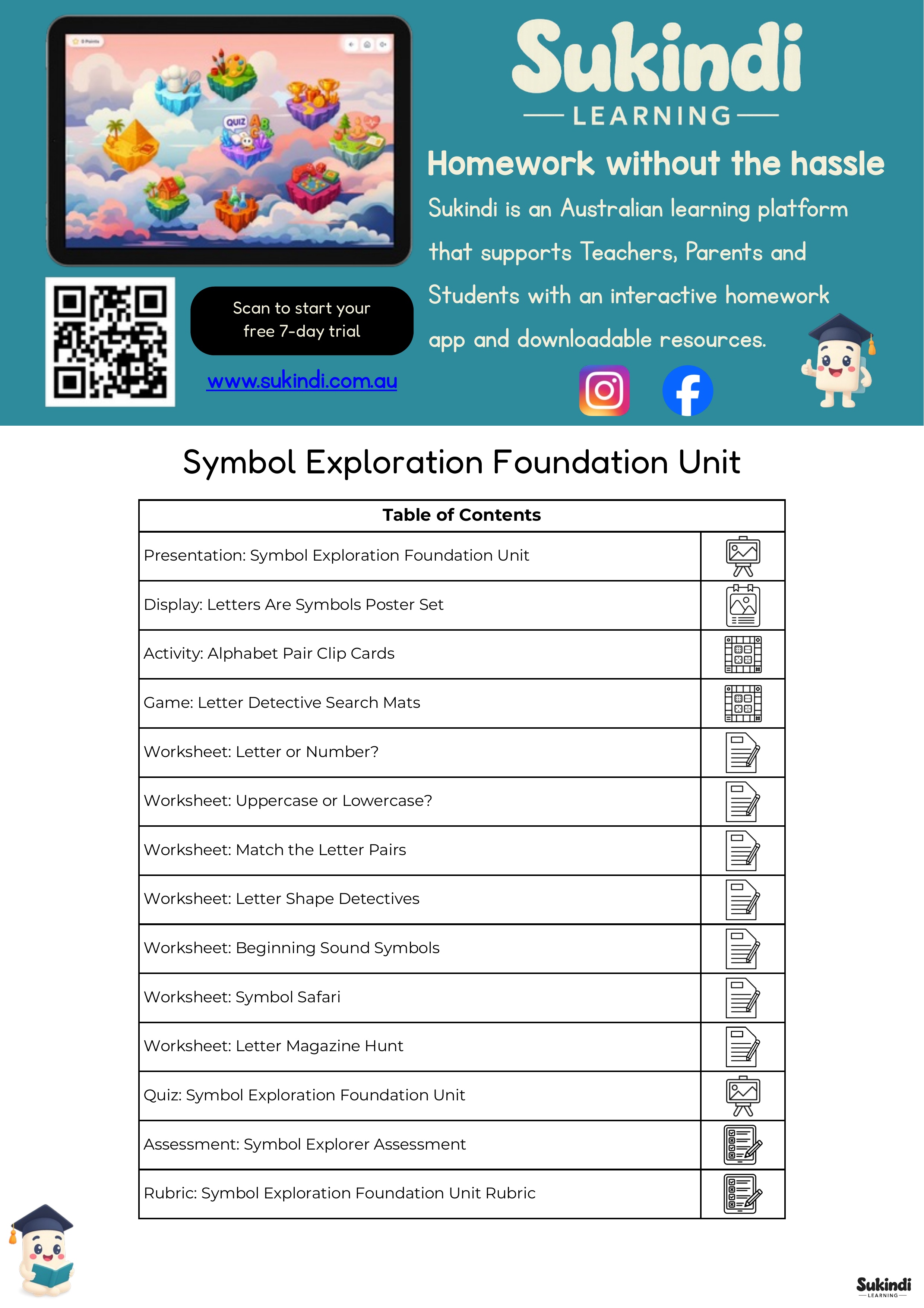
Editable PowerPoint presentation: Symbol Exploration — 19 slides
Editable PowerPoint quiz: Symbol Exploration Quiz — 22 slides
Unit Plan PDF — 38 pages
Display: Letters Are Symbols Poster Set — 3 colour pages
Activity: Alphabet Pair Clip Cards — 7 colour pages covering A–Z
Game: Letter Detective Search Mats — 5 colour pages covering A–Z
Worksheet: Letter or Number? — student and answer pages
Worksheet: Uppercase or Lowercase? — student and answer pages
Worksheet: Match the Letter Pairs — student and answer pages
Worksheet: Letter Shape Detectives — student and answer pages
Worksheet: Beginning Sound Symbols — student and answer pages
Worksheet: Symbol Safari — student and answer pages
Worksheet: Letter Magazine Hunt — 5 alphabet-range pages
Assessment: Symbol Explorer Assessment — 2 student pages + 2 answer pages
Rubric: Symbol Exploration Foundation Unit Rubric — 1 page
Learning focus
Recognise letters as a type of symbol.
Distinguish letters from numbers, signs and pictures.
Name familiar uppercase and lowercase letters.
Match uppercase letters with their lowercase forms.
Notice whether letter forms use curves, straight lines or both.
Connect familiar letters with common beginning sounds.
Apply letter knowledge through sorting, searching, matching and independent response tasks.
Classroom use
Use the presentation across approximately five literacy sessions. Follow with clip cards, search mats and worksheets in small groups or literacy rotations. The Letter Magazine Hunt supports open-ended classroom or home-language print exploration. Use the editable quiz for guided review and the assessment plus rubric for end-of-unit evidence.
Year, subject and topic
Year level: Foundation / Kindergarten
Subject: English
Topic: Letter recognition, alphabet knowledge, uppercase and lowercase letters, letter shapes, beginning sounds and symbols
Curriculum alignment
Australian Curriculum v9.0
AC9EFLY11
Australian Curriculum v8.4
ACELA1440
Victorian Curriculum 2.0
VC2EFLY06
New South Wales
ENE-PHOKW-01
Western Australia
WAPELAP3
United States Common Core
CCSS.ELA-LITERACY.RF.K.1.dCCSS.ELA-LITERACY.RF.K.3.aCCSS.ELA-LITERACY.RF.K.3.bCCSS.ELA-LITERACY.RF.K.3.d
United Kingdom
UK-KS1-Y1-ENG-R-WR
New Zealand
NZ-Y0-ENG-R-WR-PPK-3NZ-Y1-ENG-R-WR-PPK-3
Texas Essential Knowledge and Skills
TEKS-ELAR-GK-2TEKS-ELAR-GK-2BTEKS-ELAR-GK-2CTEKS-ELAR-GK-2D
Ontario Language Curriculum
CAN-G1-LANG-B2.2CAN-G1-LANG-B2.3
Formats, page counts and answers
Unit Plan PDF: 38 pages
Presentation: 19 slides
Quiz: 22 slides
Answer key: Yes — 8 red answer pages within the Unit Plan PDF
Teacher benefits
A sequenced whole-class teaching deck and aligned review quiz.
Colour resources for display, centres and games.
Black-and-white pages designed for practical classroom printing.
A–Z coverage across the clip cards, search mats and magazine-hunt pages.
Matching answer pages and a rubric for efficient checking and assessment.
Editable presentation and quiz text for classroom adaptation.
Digital product and licence
This is a digital product; no physical item is shipped. Purchase grants use by the purchasing educator with their own students, subject to the Sukindi licence. Do not resell, redistribute, share the files or post them publicly.