Types of Texts – Foundation
Click here to preview this resource
Description
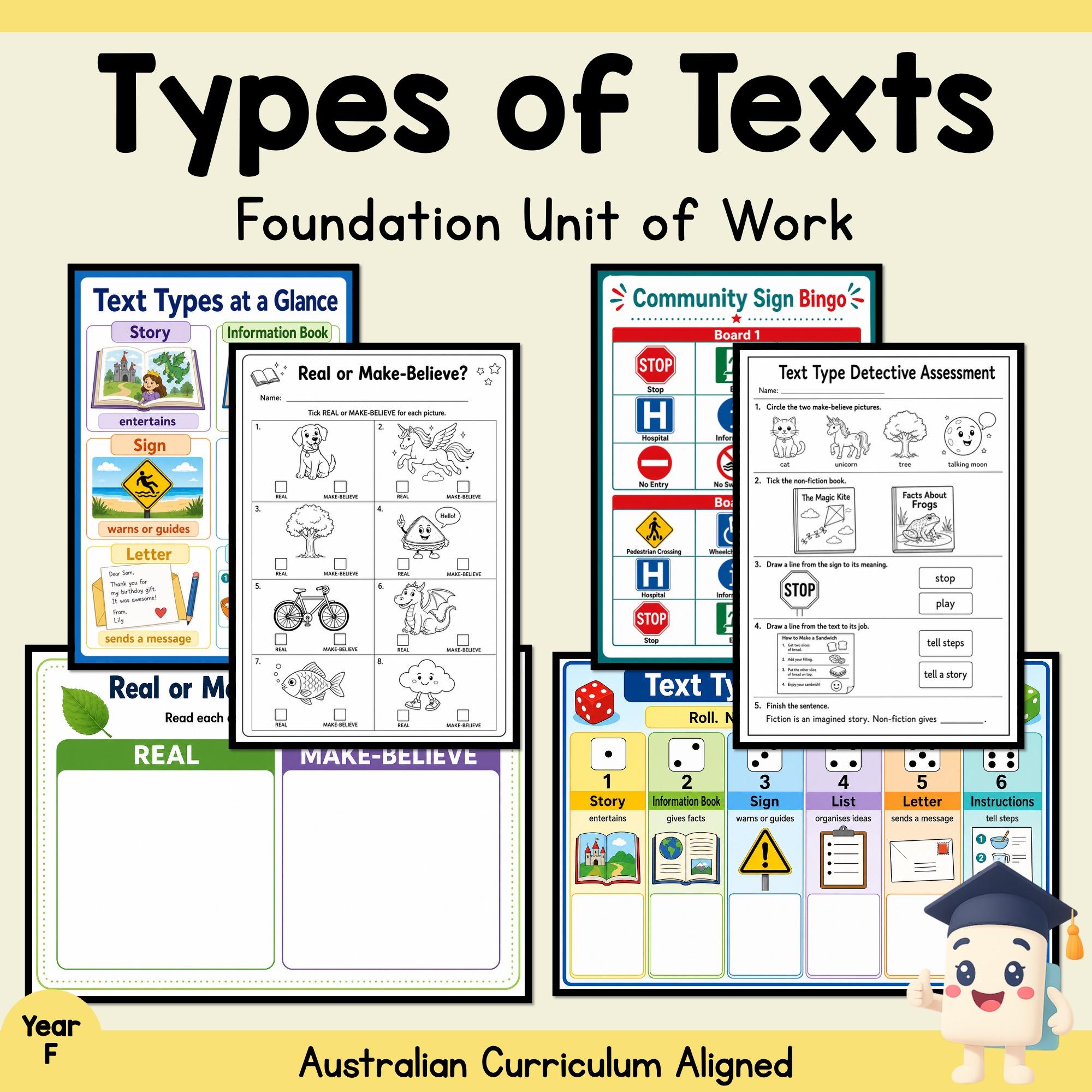
Types of Texts – Foundation helps early readers recognise and talk about the texts they meet at school and in everyday life. Students explore storybooks, information books, signs, lists, cards, letters, instructions, reports, poems, songs, shows and movies. They learn to distinguish fiction from non-fiction, sort real and make-believe ideas, explain simple text purposes and interpret common community signs.
The unit is sequenced for approximately one school week. Begin with the 14-slide editable teaching presentation, then reinforce learning through classroom displays, a real-or-make-believe card sort, Community Sign Bingo and Text Type Roll and Match. Seven low-ink worksheets provide supported, independent and creative practice. The 22-slide editable quiz, Foundation-friendly assessment and five-band rubric help teachers check understanding.
Meaningful answer pages duplicate their matching worksheet or assessment page. Red ANSWERS labels and red responses make marking quick while keeping the student task easy to compare.
What’s Included
Editable Types of Texts presentation — 14 slides
Editable Types of Texts quiz — 22 slides with 10 question-and-answer pairs
Unit plan PDF — 25 pages
Text Types at a Glance display
Fiction and Non-Fiction Clues display
Real or Make-Believe Card Sort mat
16 Real or Make-Believe cut-apart cards
Community Sign Bingo caller cards and directions
Four Community Sign Bingo boards
Text Type Roll and Match game
Real or Make-Believe? worksheet and answer page
Five Finger Retell worksheet
Library Sort worksheet and answer page
Text Type Match worksheet and answer page
Community Sign Detective worksheet and answer page
Design a Community Sign worksheet
What Is This Text For? worksheet and answer page
Text Type Detective Assessment and answer page
Types of Texts Rubric
Learning Focus
Recognising familiar text types from words, pictures and layout.
Distinguishing fiction and non-fiction.
Distinguishing real and make-believe ideas.
Explaining whether a text entertains, gives facts, warns or guides, organises, sends a message or tells steps.
Reading and explaining common community signs.
Retelling a simple story using characters, setting, beginning, middle and ending.
Classroom Use
Whole-class explicit teaching and modelling
Literacy rotations and small-group practice
Partner sorting and speaking activities
Independent worksheet practice
Formative checks, revision and assessment
Classroom display and vocabulary reference
Year, Subject and Topic
Year level: Foundation
Subject: English
Topic: Types of texts, reading, fiction and non-fiction, real and make-believe, text purpose, community signs
Curriculum Alignment
Australian Curriculum v9
AC9EFLA03, AC9EFLA08, AC9EFLE03, AC9EFLY01, AC9EFLY03
Australian Curriculum v8
ACELA1430, ACELA1437, ACELT1578, ACELT1785, ACELY1645, ACELY1648
Victorian Curriculum
VC2EFLA03, VC2EFLA08, VC2EFLE03, VC2EFLY10, VC2EFLY11
NSW English K–10 Syllabus
ENE-UARL-01, ENE-PRINT-01, ENE-VOCAB-01, ENE-RECOM-01
Western Australian Curriculum
WAPELAT1, WAPELALA4, WAPELAT2, WAPELIEX1, WAPELYT1, WAPELYA1
Common Core State Standards — English Language Arts
CCSS.ELA-LITERACY.RL.K.1, CCSS.ELA-LITERACY.RL.K.2, CCSS.ELA-LITERACY.RL.K.3, CCSS.ELA-LITERACY.RL.K.4, CCSS.ELA-LITERACY.RL.K.5, CCSS.ELA-LITERACY.RL.K.6, CCSS.ELA-LITERACY.RL.K.7, CCSS.ELA-LITERACY.RL.K.9
CCSS.ELA-LITERACY.RI.K.1, CCSS.ELA-LITERACY.RI.K.4, CCSS.ELA-LITERACY.RI.K.5, CCSS.ELA-LITERACY.RI.K.6, CCSS.ELA-LITERACY.RI.K.7, CCSS.ELA-LITERACY.RI.K.9
CCSS.ELA-LITERACY.RF.K.1
CCSS.ELA-LITERACY.L.K.1.d, CCSS.ELA-LITERACY.L.K.4, CCSS.ELA-LITERACY.L.K.4.a, CCSS.ELA-LITERACY.L.K.5, CCSS.ELA-LITERACY.L.K.5.a, CCSS.ELA-LITERACY.L.K.5.c, CCSS.ELA-LITERACY.L.K.5.d, CCSS.ELA-LITERACY.L.K.6
CCSS.ELA-LITERACY.W.K.7, CCSS.ELA-LITERACY.W.K.8
United Kingdom National Curriculum — Key Stage 1 / Year 1 English
UK-KS1-Y1-ENG-R-C, UK-KS1-Y1-ENG-SPK, UK-KS1-Y1-ENG-W-V
New Zealand Curriculum — English Years 0–1
NZ-Y0-ENG-R-C-TFG-1, NZ-Y1-ENG-R-C-TFG-1, NZ-Y0-ENG-R-C-TSSF-1, NZ-Y1-ENG-R-C-TSSF-1, NZ-Y0-ENG-R-C-SDC-1, NZ-Y1-ENG-R-C-SDC-1, NZ-Y0-ENG-OL-VG-V-1, NZ-Y1-ENG-OL-VG-V-1, NZ-Y0-ENG-OL-VG-V-2, NZ-Y1-ENG-OL-VG-V-2
Texas Essential Knowledge and Skills — Kindergarten ELAR
TEKS-ELAR-GK-2C, TEKS-ELAR-GK-3A, TEKS-ELAR-GK-3B, TEKS-ELAR-GK-3C, TEKS-ELAR-GK-4, TEKS-ELAR-GK-5A, TEKS-ELAR-GK-6F, TEKS-ELAR-GK-7, TEKS-ELAR-GK-7A, TEKS-ELAR-GK-7B, TEKS-ELAR-GK-7C, TEKS-ELAR-GK-7D, TEKS-ELAR-GK-8, TEKS-ELAR-GK-8A, TEKS-ELAR-GK-8C, TEKS-ELAR-GK-8D, TEKS-ELAR-GK-8E, TEKS-ELAR-GK-8F, TEKS-ELAR-GK-9, TEKS-ELAR-GK-9A, TEKS-ELAR-GK-11B, TEKS-ELAR-GK-12B, TEKS-ELAR-GK-12C, TEKS-ELAR-GK-12D
Ontario Language Curriculum — Kindergarten / Grade 1
CAN-GK-LANG-OE9, CAN-GK-LANG-OE11, CAN-GK-LANG-OE12, CAN-G1-LANG-B2.7, CAN-G1-LANG-C1.1, CAN-G1-LANG-C1.2, CAN-G1-LANG-C1.3, CAN-G1-LANG-D1.2
Formats, Page Count and Answer Status
Formats: PDF and editable PowerPoint
Unit plan: 25 pages
Presentation: 14 slides
Quiz: 22 slides
Combined Preview: 61 pages
Answer keys: Five worksheet answer pages and one assessment answer page included
Teacher Benefits
A complete teaching sequence with explanation, guided practice, games, independent work and assessment.
Large, clear Foundation-level examples support oral language and early reading.
Colour hands-on resources and low-ink worksheet pages suit different classroom uses.
Red answer pages make responses quick to compare without changing the student layout.
Editable presentation and quiz text support flexible pacing.
Digital Product and Licence
This is a digital product. No physical item will be shipped. Purchase permits use by one teacher in one classroom or one household. Files may not be shared, resold, redistributed or posted publicly. Additional users require additional licences.