Visualising Reading Strategy – Year 6
Click here to preview this resource
Description
Develop confident, evidence-based reading comprehension with this Year 6 visualising strategy unit. Students learn to create mental images from sensory details, precise vocabulary and prior knowledge, then monitor those images as a text develops and revise them when new evidence changes the scene.
The sequence begins with explicit modelling and shared language for Build, Check and Revise. It then moves through fiction and nonfiction practice, spatial and process texts, inference about setting and character, image monitoring, and comparison of plausible interpretations. Collaborative resources extend the strategy through Mental Movie Studio and Forbidden Clues, while The Night Crossing assessment and five-level rubric provide a coherent end-of-unit evidence set.
The unit is designed for approximately one school week and includes editable presentation and quiz files, a print-ready unit plan, differentiated practice, matching answer pages, activity and game materials, assessment and marking support.
What’s Included
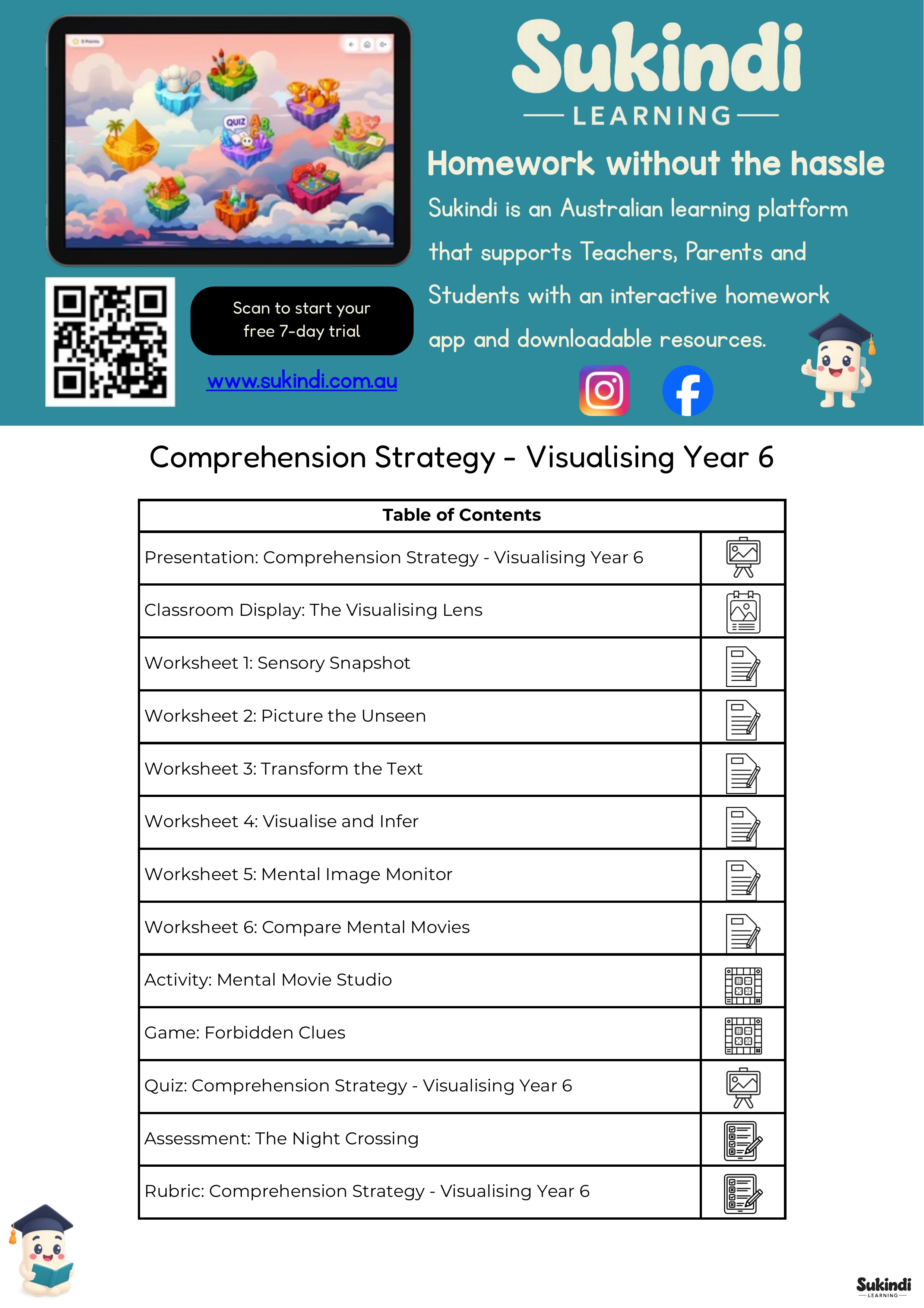
32-page Unit Plan PDF with a clean Sukindi Table of Contents page and 31 resource pages
25-slide editable PowerPoint presentation with native lesson text
23-slide editable PowerPoint quiz with 10 question-and-answer pairs
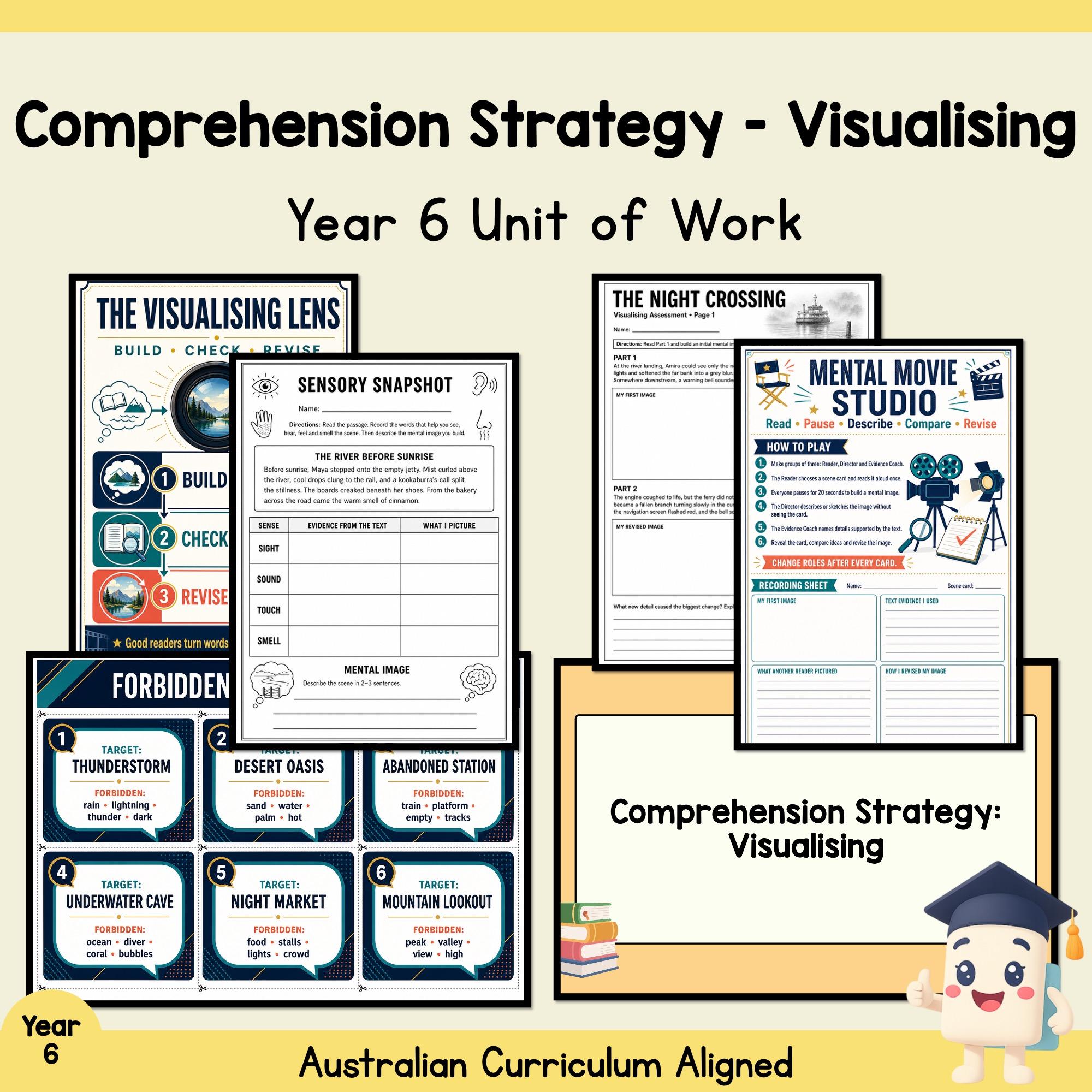
Classroom display: The Visualising Lens — Build, Check, Revise
Sensory Snapshot worksheet and answer page
Picture the Unseen fiction and nonfiction worksheets with two answer pages
Transform the Text process and spatial worksheets with two answer pages
Visualise and Infer setting and character worksheets with two answer pages
Mental Image Monitor build/check practice with one answer page
Compare Mental Movies worksheet
Mental Movie Studio instructions, scene cards and recording structure
Forbidden Clues instructions and two pages of game cards
The Night Crossing three-page assessment with three answer pages
Comprehension Strategy - Visualising Year 6 Rubric with five performance levels
80-page combined Preview PDF
Learning Focus
Use sensory details, vocabulary and prior knowledge to form a mental image
Select and explain text evidence that supports a visualisation
Monitor and revise a mental image as new information appears
Use visualising to support inference about setting, character, mood and meaning
Compare different plausible images and justify each interpretation
Communicate a scene clearly through precise oral and written language
Classroom Use
Use the editable presentation for daily modelling and shared examples, then select the paired worksheet pages for supported, core or extended practice. Mental Movie Studio works well in small groups with rotating roles. Forbidden Clues can be used as a whole-class review, literacy rotation or fast-finisher task. Complete the unit with The Night Crossing assessment and the accompanying rubric.
Year, Subject and Topic
Year level: Year 6
Subject: English
Topic: Reading comprehension — visualising and mental imagery
Suggested duration: Five lessons / approximately one school week
Curriculum Alignment
Australian Curriculum v9.0
AC9E6LY05
Australian Curriculum v8.4
ACELY1713
Victorian Curriculum 2.0
VC2E6LY08
NSW English K–10
EN3-OLC-01; EN3-RECOM-01; EN3-UARL-01; EN3-UARL-02
Western Australian Curriculum
WA6ELYA3
Common Core State Standards
CCSS.ELA-LITERACY.RI.6.1; CCSS.ELA-LITERACY.RI.6.2; CCSS.ELA-LITERACY.RI.6.3; CCSS.ELA-LITERACY.RI.6.4; CCSS.ELA-LITERACY.RL.6.1; CCSS.ELA-LITERACY.RL.6.2; CCSS.ELA-LITERACY.RL.6.3; CCSS.ELA-LITERACY.RL.6.4; CCSS.ELA-LITERACY.L.6.4.a; CCSS.ELA-LITERACY.L.6.4.d; CCSS.ELA-LITERACY.L.6.5.b; CCSS.ELA-LITERACY.L.6.5.c; CCSS.ELA-LITERACY.RI.6.10; CCSS.ELA-LITERACY.RL.6.10; CCSS.ELA-LITERACY.SL.6.1.a; CCSS.ELA-LITERACY.SL.6.3; CCSS.ELA-LITERACY.W.6.1.b; CCSS.ELA-LITERACY.W.6.2.b; CCSS.ELA-LITERACY.W.6.7; CCSS.ELA-LITERACY.W.6.8; CCSS.ELA-LITERACY.W.6.9.b; CCSS.ELA-LITERACY.W.6.10
UK English
UK-KS3-ENG-W; UK-KS3-ENG-R-WR; UK-KS3-ENG-G
New Zealand English
NZ-Y6-ENG-OL-C-CM-1; NZ-Y6-ENG-OL-C-IUE-1; NZ-Y6-ENG-OL-C-SDC-1
Texas Essential Knowledge and Skills
TEKS-ELAR-G6-8F; TEKS-ELAR-G6-2B; TEKS-ELAR-G6-3; TEKS-ELAR-G6-4; TEKS-ELAR-G6-5; TEKS-ELAR-G6-5A; TEKS-ELAR-G6-5B; TEKS-ELAR-G6-5C; TEKS-ELAR-G6-5D; TEKS-ELAR-G6-5E; TEKS-ELAR-G6-5F; TEKS-ELAR-G6-5G; TEKS-ELAR-G6-5H; TEKS-ELAR-G6-5I; TEKS-ELAR-G6-6A; TEKS-ELAR-G6-6B; TEKS-ELAR-G6-6C; TEKS-ELAR-G6-6D; TEKS-ELAR-G6-6E; TEKS-ELAR-G6-6G; TEKS-ELAR-G6-6I; TEKS-ELAR-G6-7A; TEKS-ELAR-G6-8B; TEKS-ELAR-G6-8D; TEKS-ELAR-G6-8E; TEKS-ELAR-G6-9; TEKS-ELAR-G6-9A; TEKS-ELAR-G6-10; TEKS-ELAR-G6-12; TEKS-ELAR-G6-12A; TEKS-ELAR-G6-12C; TEKS-ELAR-G6-12D; TEKS-ELAR-G6-12E; TEKS-ELAR-G6-12F
Ontario Language Curriculum
CAN-G6-LANG-C2.3; CAN-G6-LANG-C2.4; CAN-G6-LANG-C2.6; CAN-G6-LANG-B2.3; CAN-G6-LANG-C2.1; CAN-G6-LANG-C2.5; CAN-G6-LANG-C2.7; CAN-G6-LANG-C3.2; CAN-G6-LANG-C3.8
Formats, Page Count and Answer Status
Unit Plan PDF: 32 pages
Editable presentation PPTX: 25 slides
Editable quiz PPTX: 23 slides
Combined Preview PDF: 80 pages
Answer keys: 11 matching resource answer pages plus quiz answer slides
Teacher Benefits
One coherent lesson sequence links modelling, practice, collaboration and assessment
Fiction and nonfiction tasks allow the strategy to transfer across text types
Matching answer pages support efficient review and feedback
Editable presentation and quiz text allow teachers to adapt delivery for their class
A five-level rubric supports consistent marking and student reflection
Digital Product and Licence
This is a digital product; no physical item is supplied. Purchase grants a single-user licence for use by one teacher with their own classes. Files may not be redistributed, shared publicly, resold or uploaded to another platform.