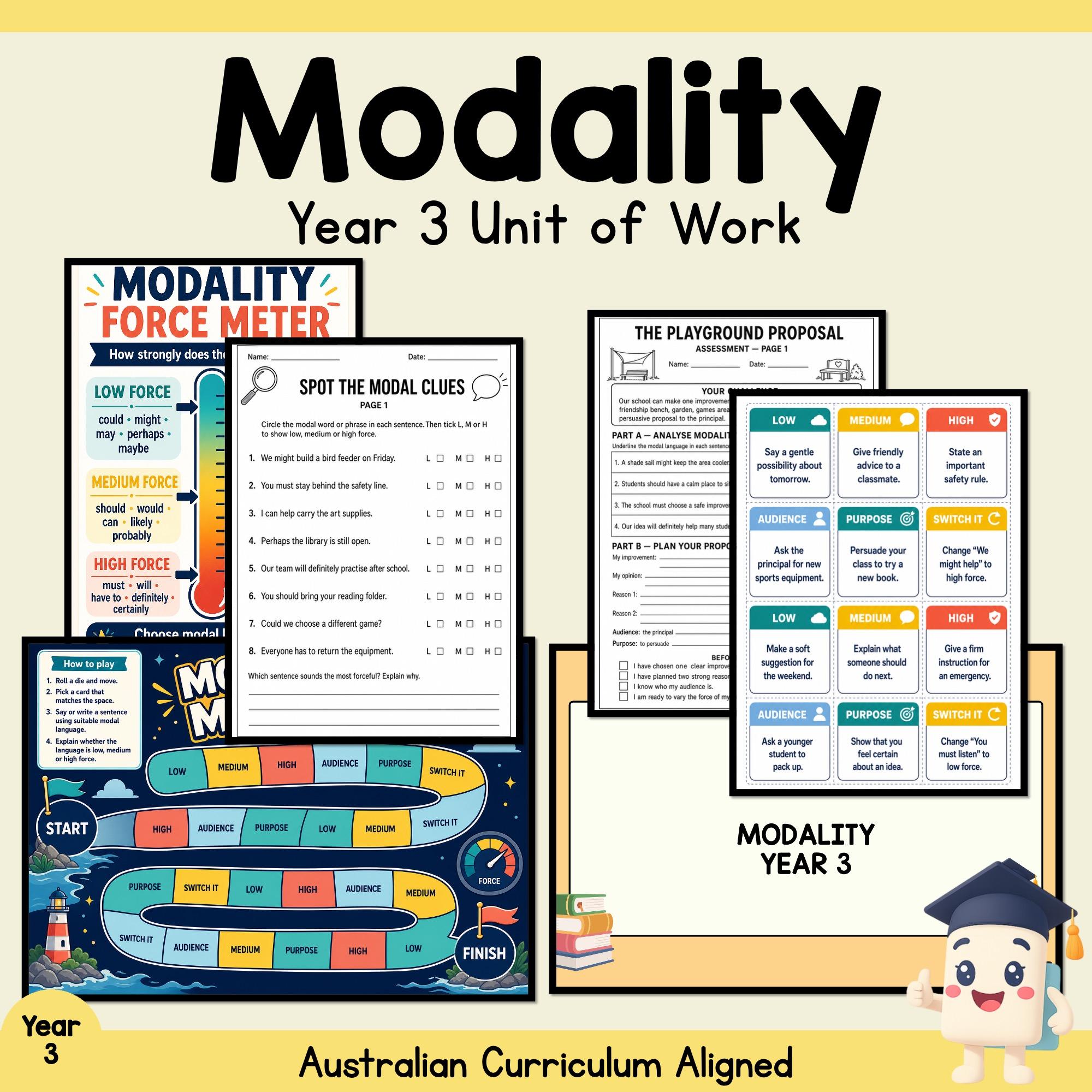
Year 3 Modality Unit
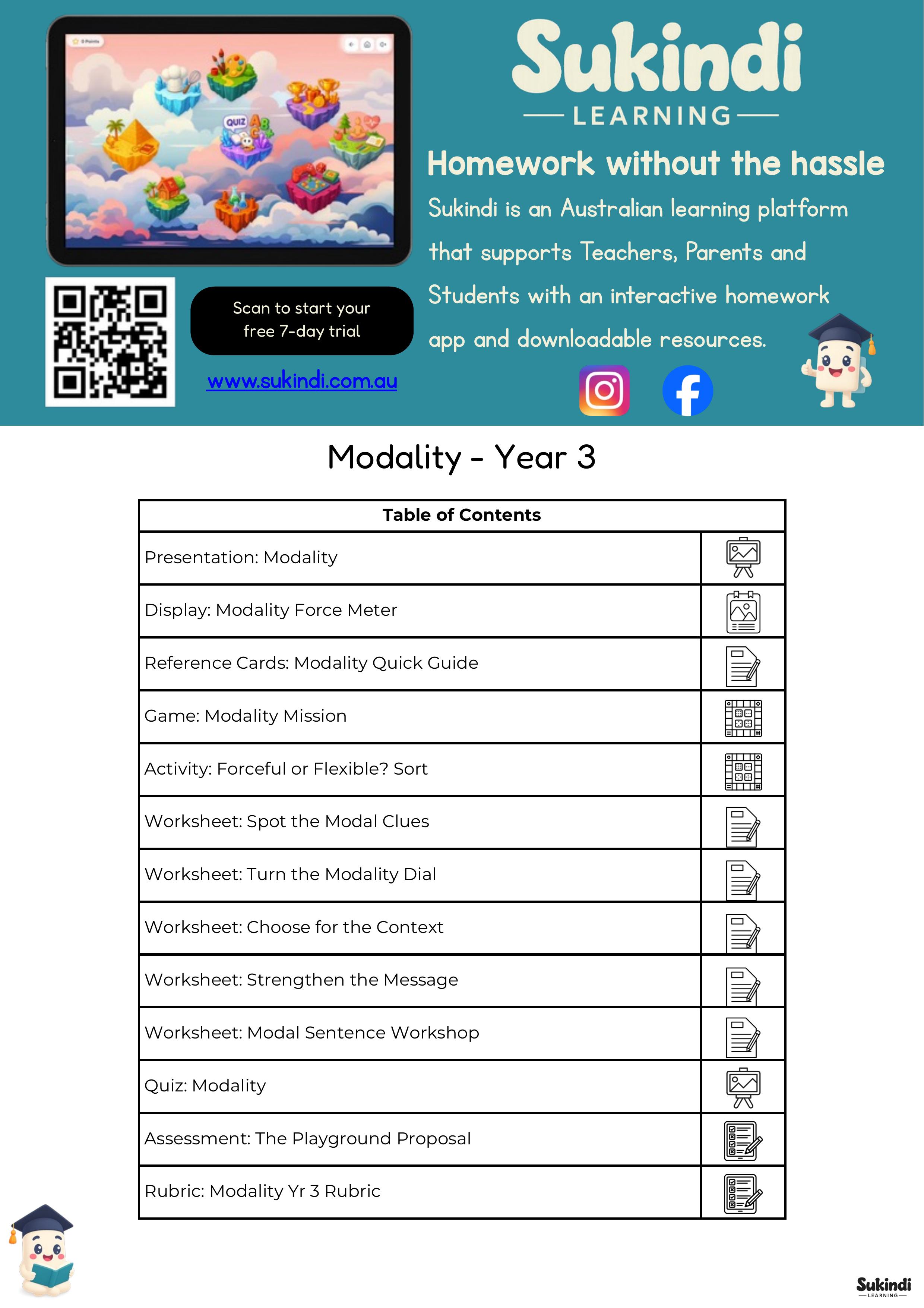
Click here to preview this resource
Give Year 3 students a practical way to understand modality and use it deliberately. This complete English unit teaches how modal verbs and modal adverbs position a message from low to high force, and how effective writers adjust certainty, possibility, obligation and evaluation for a particular audience and purpose.
The learning sequence begins with a 20-slide editable PowerPoint presentation and two clear visual supports: the Modality Force Meter and Modality Quick Guide. Students then apply the language through the Modality Mission board game, a Forceful or Flexible? sorting activity and five sequenced two-page worksheet sets. The tasks progress from recognising modal clues to comparing strength, choosing language for context, rewriting messages and composing persuasive sentences.
The editable 22-slide quiz provides 10 questions with a matching answer and explanation slide after each question. The unit concludes with The Playground Proposal, a two-page applied persuasive-writing assessment, and the Modality Yr 3 Rubric. Fixed-response worksheet and assessment tasks include red-answer teacher pages; open-ended writing is supported by success criteria and the rubric.
What's Included
Modality Yr 3 - Presentation.pptx — 20 editable teaching slides
Modality Yr 3 - Quiz.pptx — 22 editable slides with 10 questions and matching answer/explanation slides
Modality Yr 3 - Unit Plan.pdf — 26 A4 pages
Modality Force Meter classroom display
Modality Quick Guide reference cards
Modality Mission board game and cards
Forceful or Flexible? sorting mats and sentence cards
Spot the Modal Clues — two student pages plus a fixed-response answer page
Turn the Modality Dial — two student pages plus a fixed-response answer page
Choose for the Context — two student pages plus a fixed-response answer page
Strengthen the Message — two student pages plus a fixed-response answer page
Modal Sentence Workshop — two student pages plus a fixed-response answer page
The Playground Proposal — two assessment pages plus a structured answer page
Modality Yr 3 Rubric
Learning Focus
Identify modal verbs and modal adverbs in sentences
Place language choices on a low-, medium- and high-force continuum
Explain how modality changes certainty, possibility, obligation and evaluation
Match force to audience and purpose
Strengthen or soften requests, rules and persuasive statements
Apply modality in sentence and paragraph writing
Review written work against explicit criteria
Classroom Use
Use the presentation for explicit whole-class teaching, the display and reference cards for ongoing visual support, and the game or sorting activity for collaborative practice. The worksheets can be taught as a sequence, used for consolidation or selected for small-group support and extension. Finish with the editable quiz, The Playground Proposal assessment and the rubric.
Suggested duration: approximately five lessons across one school week, with additional pages available for consolidation or extension.
Product Details
Year level: Year 3
Subject: English
Topic: Modality, modal verbs, modal adverbs, certainty and force
Primary curriculum code: AC9E3LA02
Curriculum Alignment
Australian Curriculum Version 9
AC9E3LA02
Australian Curriculum Version 8.4
ACELA1477
Victorian Curriculum
VC2E3LA02
VC2E3LA09
NSW English K–10 Syllabus
EN2-OLC-01
EN2-VOCAB-01
Western Australian Curriculum
WA3ELAI2
Common Core State Standards
L.3.1.g
L.3.3
L.3.3.a
L.3.3.b
L.3.4
L.3.5
L.3.5.a
L.3.5.b
L.3.5.c
RI.3.4
England National Curriculum
UK-LKS2-Y4-ENG-SPK
UK-LKS2-ENG-W-V
New Zealand Curriculum
NZ-Y3-ENG-OL-CII-VR-1
NZ-Y3-ENG-OL-CII-VR-2
NZ-Y3-ENG-OL-CII-PTO-1
NZ-Y4-ENG-OL-CII-VR-1
Texas Essential Knowledge and Skills
G3-10D
G3-10F
G3-1C
Ontario Language Curriculum
CAN-G3-LANG-B1.5
CAN-G3-LANG-B3.2
CAN-G3-LANG-C1.5
Formats, Page Counts and Answers
File formats: PDF and editable Microsoft PowerPoint PPTX
Unit plan: 26 A4 pages
Presentation: 20 slides
Quiz: 22 slides
Answer support: Six red-answer teacher pages for fixed-response worksheet and assessment tasks; open-ended responses use the supplied rubric
Teacher Benefits
A coherent progression from recognition to independent application
Visual, collaborative, written and assessment tasks in one unit
Editable teaching and quiz decks
Print-friendly worksheet and assessment pages
Answers for fixed-response tasks and a clear rubric for open-ended writing
Flexible resources for whole-class, small-group and independent use
Digital Product and Licence
This is a digital product. No physical item will be shipped. The purchase is for use by the purchasing teacher in one classroom. The files may not be resold, redistributed, shared publicly or uploaded to a public or shared repository. Additional users require their own licence, subject to Sukindi's current terms.