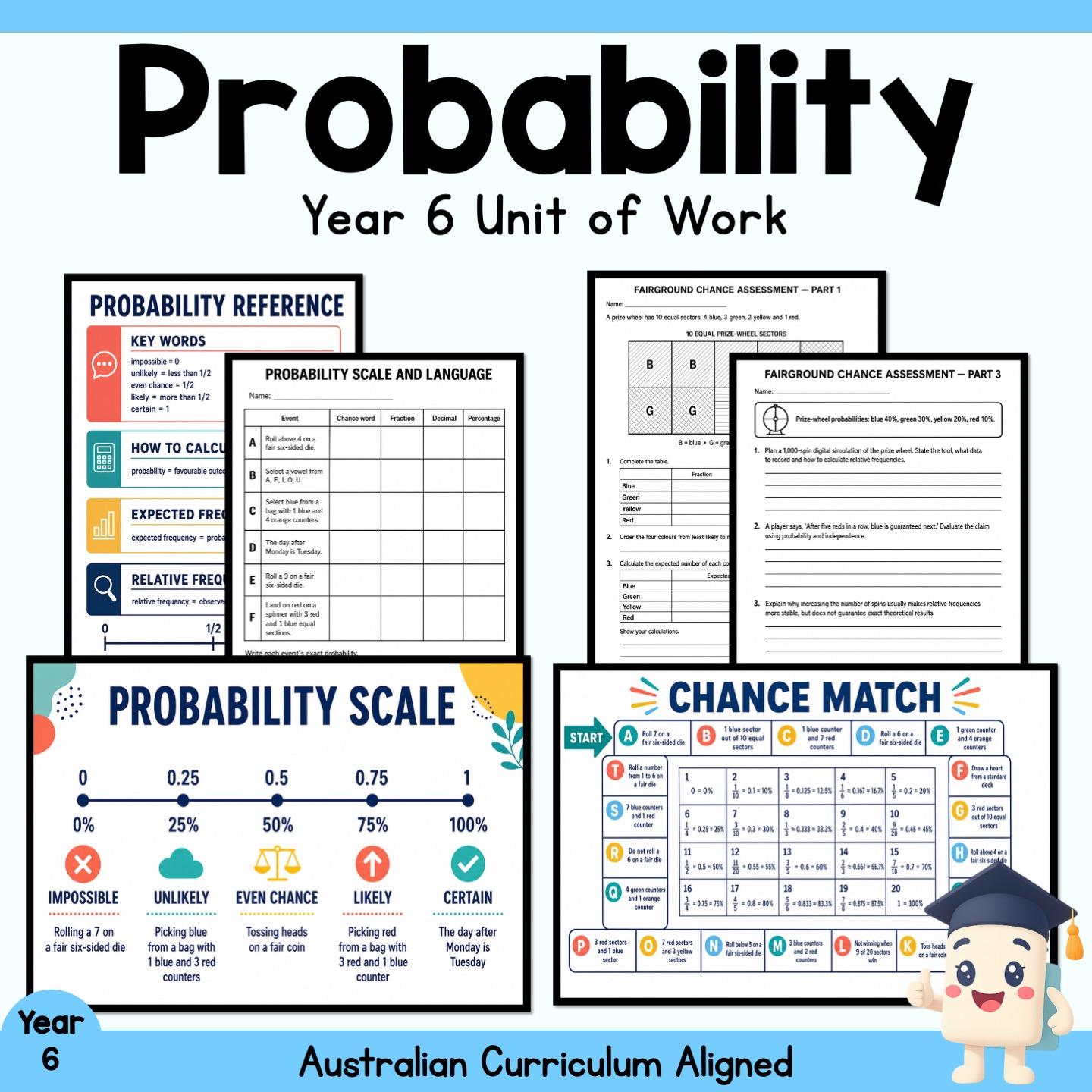
Year 6 Probability Unit
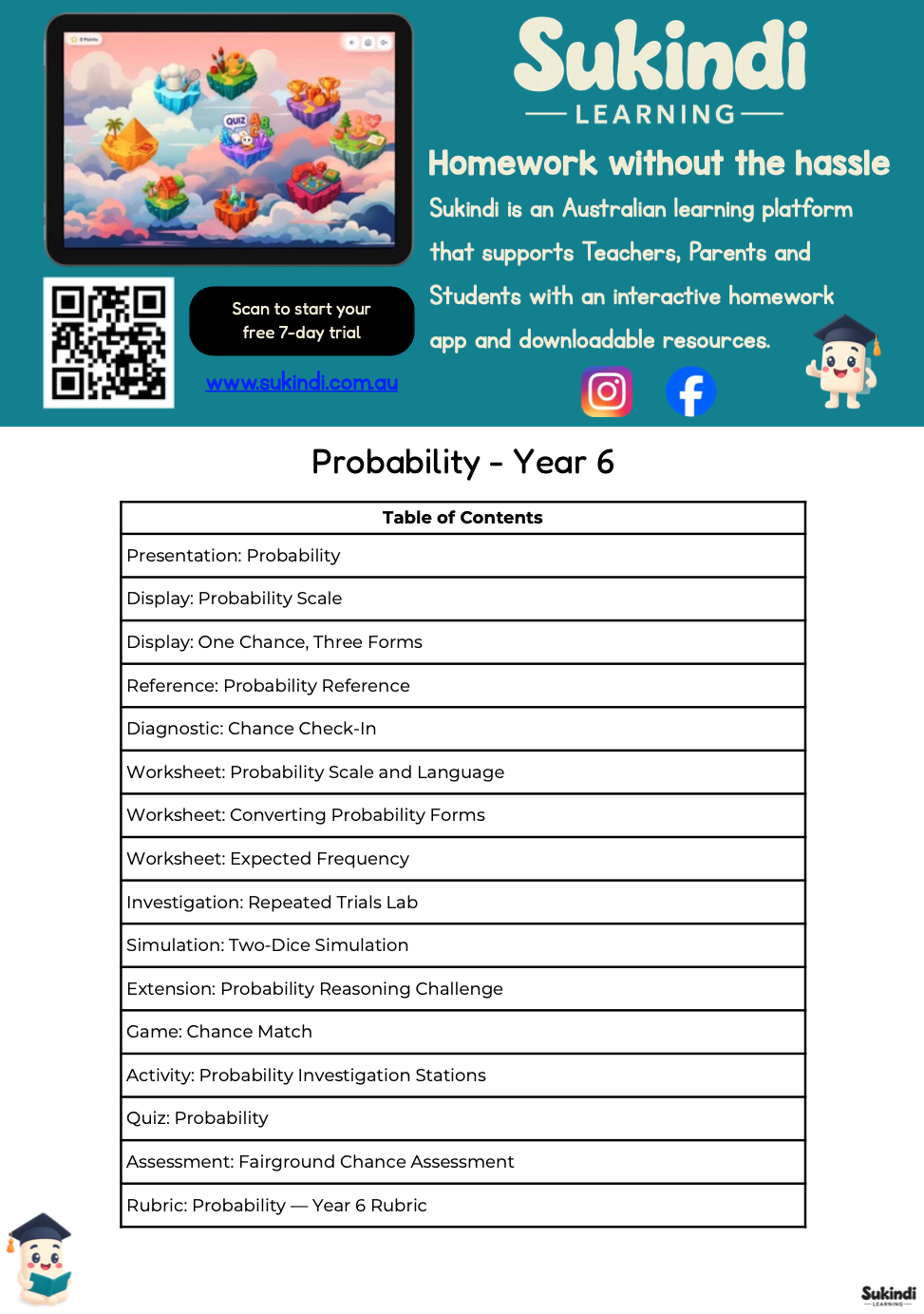
Click here to preview this resource
About this unit
Teach probability through a balanced sequence of explicit instruction, visual representations, guided practice, simulation and hands-on investigation. This Year 6 Mathematics unit helps students express probabilities as fractions, decimals and percentages; calculate expected frequencies; collect and analyse repeated-trial data; compare theoretical probability with observed relative frequency; and reason about variation, sample size, independence and non-uniform outcomes.
The editable 20-slide presentation supports whole-class teaching. The 43-page unit plan PDF then provides a diagnostic check, colour displays, a concise reference page, scaffolded and extended worksheet practice, a repeated-trials lab, a two-dice simulation, a Chance Match game and five investigation stations. The editable 22-slide quiz alternates ten varied questions with their answers. A three-part fairground assessment, fourteen interleaved answer pages and a five-level rubric complete the sequence.
What's included
Probability editable PowerPoint presentation — 20 slides.
Probability Quiz editable PowerPoint — 22 slides, including 10 question-and-answer pairs.
43-page A4 unit plan PDF with:
Probability Scale colour display — 1 page.
One Chance, Three Forms colour display — 1 page.
Probability Reference — 1 page.
Chance Check-In diagnostic and answer — 2 pages.
Probability Scale and Language worksheet and answer — 2 pages.
Converting Probability Forms: Core and Reasoning worksheets and answers — 4 pages.
Expected Frequency: From Chance to Count and Scaling Expected Outcomes worksheets and answers — 4 pages.
Repeated Trials Lab: Record, Analyse and answer pages — 3 pages.
Two-Dice Simulation: Theoretical Model, 100 Trials, Compare Trial Sizes and answers — 6 pages.
Probability Reasoning Challenge and answer — 2 pages.
Chance Match board and card game — 2 colour pages.
Probability Investigation Stations: setup, score sheet, card-draw station, dice-data station, coin-independence station, mystery-bag station and weighted-randomiser station — 7 colour pages.
Fairground Chance Assessment Parts 1–3 and answers — 6 pages.
Probability — Year 6 Rubric — 1 page.
Learning focus
Place and describe events on a probability scale.
Connect fractions, decimals and percentages as equivalent probability forms.
Calculate expected frequencies from theoretical probabilities.
Conduct repeated chance experiments and record results efficiently.
Calculate and compare observed relative frequencies.
Explain random variation and the stabilising effect of larger samples.
Investigate independent events and weighted or non-uniform outcomes.
Justify conclusions using numerical evidence.
Classroom use
Use the presentation to introduce and model each concept, then select the diagnostic, worksheets and reference page for guided or independent practice. Run the repeated-trials lab and two-dice simulation in pairs, use Chance Match for consolidation, and rotate groups through the five investigation stations. Finish with the quiz for immediate feedback and the fairground assessment with rubric for summative judgement. The extension challenge supports students ready for deeper reasoning.
Year, subject and topic
Year level: Year 6
Subject: Mathematics
Topic: Probability, chance experiments, expected frequency and relative frequency
Curriculum alignment
Australian Curriculum v9.0: AC9M6P01; AC9M6P02
Australian Curriculum v8.4: ACMSP144; ACMSP145; ACMSP146
Victorian Curriculum 2.0: VC2M6P01; VC2M6P02
NSW Curriculum: MA3-CHAN-01
Western Australian Curriculum: ACMSP144; ACMSP145; ACMSP146
Common Core: CCSS.MATH.CONTENT.6.SP.B.5.c; CCSS.MATH.CONTENT.6.RP.A.3.c; CCSS.MATH.CONTENT.6.SP.A.1; CCSS.MATH.CONTENT.6.SP.A.2; CCSS.MATH.CONTENT.6.SP.A.3; CCSS.MATH.CONTENT.6.SP.B.4; CCSS.MATH.CONTENT.6.SP.B.5
England / UK: UK-UKS2-Y6-MATH-S; UK-KS3-MATH-P
New Zealand: NZ-Y6-MATH-STAT-PROB-1
Texas TEKS: TEKS-MATH-G6-4E; TEKS-MATH-G6-4F; TEKS-MATH-G6-4G; TEKS-MATH-G6-12A; TEKS-MATH-G6-12B; TEKS-MATH-G6-13A
Ontario: CAN-G6-MATH-D2.1; CAN-G6-MATH-D2.2
Formats, page counts and answers
Unit plan: 43 A4 pages.
Presentation: 20 slides.
Quiz: 22 slides with 10 question-and-answer pairs.
Answer key: Included. Fourteen answer pages are placed directly after the matching worksheet or assessment page.
Colour/print format: Displays, games and station materials are in colour; worksheets, assessment pages and rubric are black and white; answer text is red.
Teacher benefits
Provides a sequenced week of teaching rather than isolated practice sheets.
Combines visual, written, practical and numerical probability experiences.
Includes support, core practice, extension and summative assessment.
Keeps answers beside the matching tasks for efficient marking.
Supplies editable teaching and quiz slides for flexible classroom delivery.
Uses practical data sets and repeated trials to connect theory with evidence.
Digital product and licence
This is a digital product; no physical item is supplied. Purchase grants use by the purchasing teacher in one classroom, subject to Sukindi's current licence terms. Do not resell, redistribute, share publicly or post the files online. Additional users require the appropriate additional licence.